
2026, n.º 41, e2026419
Pedro Nuno de Oliveira
ROLES: Conceptualization, Investigation, Methodology, Writing – original draft, Writing – review & editing.
AFILLIATION: Instituto Português de Relações Internacionais, Universidade Nova de Lisboa.
Rua de D. Estefânia, 195, 5.º D, 1000-155 Lisboa, Portugal.
E-mail: 76pno.autor@gmail.com | ORCID: https://orcid.org/0000-0003-2941-1519
Abstract: This article examines how institutional challenges within the Portuguese Independent Living Support Model [MAVI/SAVI] can be addressed through cross sectoral policy learning. Drawing on the theoretical frameworks of policy transfer, translation and institutional bricolage, the study analyses consolidated practices in three domains: aviation safety protocols, direct payment mechanisms in agricultural and science, technology and innovation policies, and competence recognition systems in vocational training. Using a qualitative and exploratory methodology based on secondary sources, the article identifies transferable principles and assesses their applicability to the Portuguese context. The findings suggest that adapted—not replicated—practices from these sectors could strengthen MAVI/SAVI’s institutional design by enhancing risk prevention mechanisms, introducing flexible and personalised funding instruments, and recognising experiential knowledge as a legitimate source of expertise. Overall, the study highlights the transformative potential of user centred governance, decentralised decision making and competence-based certification in advancing independent living in Portugal.
Keywords: independent living, policy transfer, policy translation, institutional bricolage.
Resumo: Este artigo examina de que forma os desafios institucionais do Modelo de Apoio/Serviço de Apoio à Vida Independente em Portugal [MAVI/SAVI] podem ser abordados através da aprendizagem intersectorial de políticas públicas. Com base nos enquadramentos teóricos da transferência de políticas, da tradução e da bricolage institucional, o estudo analisa práticas consolidadas em três domínios: protocolos de segurança na aviação, mecanismos de pagamento direto nas políticas agrícolas e de ciência, tecnologia e inovação, e sistemas de reconhecimento de competências na formação profissional. Recorrendo a uma metodologia qualitativa e exploratória baseada em fontes secundárias, o artigo identifica princípios transferíveis e avalia a sua aplicabilidade ao contexto português. Os resultados sugerem que práticas adaptadas – e não replicadas – destes setores podem reforçar o desenho institucional do MAVI/SAVI, melhorando os mecanismos de prevenção de riscos, introduzindo instrumentos de financiamento flexíveis e personalizados e reconhecendo o conhecimento experiencial como uma fonte legítima de especialização. No conjunto, o estudo evidencia o potencial transformador de modelos de governação centrados no utilizador, da descentralização da tomada de decisão e da certificação baseada em competências para o avanço da vida independente em Portugal.
Palavras chave: vida independente, transferência de políticas, tradução de políticas, bricolage institucional.
Introduction
Recent political science literature has increasingly focused on lesson drawing, policy transfer and translation, emphasising how ideas, instruments and institutional arrangements circulate across sectors and jurisdictions. In the field of disability policy, these debates intersect with the Independent Living paradigm—a global philosophy and movement that upholds self determination, dignity and the right of disabled people to full and effective citizenship. Under this paradigm, a lack of physical autonomy does not imply a lack of decision making sovereignty over one’s life, nor a lack of control over the resources required to exercise that citizenship in practice (European Network on Independent Living, 1990; Ratzka, 2007).
In Portugal, the Independent Living Support Model (MAVI/SAVI[1]) was introduced in 2017 to operationalise these principles through personalised assistance delivered via Independent Living Centres[2]. A previous study (Oliveira, 2020) assessed whether the model enhances user control over support services, arguing for more personalised, flexible and community based arrangements. Although MAVI/SAVI has evolved significantly since its introduction, several institutional challenges persist—particularly in the areas of risk prevention, funding mechanisms and the recognition of experiential competences.
This article examines how these challenges can be addressed through cross sectoral learning. It analyses consolidated practices in three domains: aviation (risk prevention and safety), agricultural and scientific policy (direct payment mechanisms), and vocational education and training (recognition and certification of competences). These sectors were selected based on three criteria: i) the existence of institutionalised mechanisms for prevention, certification or direct funding; ii) regulatory maturity that allows the identification of stable and transferable practices; and iii) their relevance to specific gaps within MAVI/SAVI, including the absence of competence certification for users, the lack of flexible funding instruments and the absence of formal safeguarding protocols.
This article does not focus on the official interim evaluation report of MAVI/SAVI. Instead, it seeks to develop a sociopolitical and institutional analysis of the model, using the Independent Living Movement [ILM] and the Convention on the Rights of Persons with Disabilities [CRPD] as its normative framework. This framework makes it possible to identify gaps that the report, owing to its descriptive nature, does not address.
Anchored in the literature on policy transfer, lesson drawing, translation and institutional bricolage, and informed by the international framework established by the CRPD—the guiding document for disability policy at the global level (European Commission & Directorate-General for Employment, Social Affairs and Inclusion, 2021; Convention on the Rights of Persons with Disabilities, opened for signature 30 March 2007, 2515 UNTS 3 (entered into force 3 May 2008))—the article analyses the legislative evolution of MAVI/SAVI and identifies adaptable practices that could strengthen its institutional design. The study argues that meaningful reform requires not the replication of external models, but their translation into solutions that respect the principles of the Independent Living Movement and the specificities of the Portuguese context.
The article proceeds as follows. The section “Policy transfer: A focused literature review” presents a focused literature review on policy transfer. The section “The Portuguese MAVI/SAVI in context: Legislative evolution and insufficiencies” analyses the legislative evolution of MAVI/SAVI and identifies the main insufficiencies in its institutional architecture. Section 4 explores transferable practices from three sectors: agriculture and science, and vocational training, assessing their relevance to MAVI/SAVI’s reform. The final section presents the study’s main conclusions and policy implications.
Method
This study adopts a qualitative and exploratory research design grounded in the analysis of secondary sources. From a neo institutionalist perspective, the aim is not to identify causal regularities but to understand how institutional arrangements, organisational logics and sector specific norms shape the emergence of stable practices that may be meaningfully translated into the field of independent living. Accordingly, the analysis focuses on institutional architectures rather than on individual behaviours, emphasising how rules, routines and governance mechanisms structure policy outcomes.
A wide range of international databases and institutional archives were consulted—including Google Scholar, International Air Transport Association [IATA], International Civil Aviation Organization [ICAO], the European Commission, Organisation for Economic Co-operation and Development [OECD] and Fundação para Ciência e Tecnologia [FCT]—with a thematic focus on three domains: aviation safety protocols, direct funding mechanisms in agricultural and science, technology and innovation policy, and competence recognition systems in vocational training. These sectors were not selected as empirical cases to be replicated, but as conceptual exemplars whose institutional configurations offer insights into how different policy fields organise prevention, funding and certification.
The selection of these three sectors follows three neo institutionalist criteria:
i) Each domain exhibits institutionalised mechanisms—of prevention, certification or direct funding—that have become routinised and stable over time, allowing the identification of consolidated practices.
ii) These sectors display a high degree of regulatory maturity, providing clear governance structures, procedural standards and accountability mechanisms that can be analytically compared.
iii) Each sector offers potential relevance to specific institutional gaps within MAVI/SAVI, namely: a) the absence of formal risk prevention and safeguarding protocols; b) the lack of flexible and personalised funding instruments; and c) the absence of mechanisms for recognising experiential competences acquired by users and personal assistants.
Rather than aiming for generalisation, the study employs analytical generalisation, typical of neo institutionalist research, whereby insights from mature institutional fields are used to illuminate structural weaknesses and possible reform pathways in another policy domain. This approach aligns with the literature on policy transfer, translation and institutional bricolage, which emphasises selective adaptation, contextual mediation and the recombination of institutional elements rather than direct replication.
It is important to clarify that the selection of the three sectors did not precede the identification of MAVI/SAVI’s institutional challenges. Rather, it was the diagnosis of specific gaps—namely the absence of safeguarding mechanisms, the lack of flexible funding instruments, and the non-recognition of experiential competences—that motivated the search for mature institutional fields capable of offering conceptual exemplars. The aviation sector, in particular, is not presented as a prescriptive model for independent living, but as an analytical case that illustrates how formal safeguarding mechanisms operate in a highly regulated environment. As Dismukes et al. (2007) observe, aviation is a context where human error and dependency are tightly managed through structured protocols, highlighting how safety in high-risk environments relies on the competence and conduct of others. Similarly, disabled individuals often depend not only on access to services, but on the reliability and ethical behaviour of those providing support.
Policy transfer: A focused literature review
The literature on policy transfer has evolved from descriptive approaches to analytical models that explain how ideas and instruments circulate across sectors and jurisdictions. For the purposes of this article, three concepts are particularly relevant: lesson drawing, translation and institutional bricolage.
Lesson drawing
According to Dolowitz and Marsh (2000), lesson drawing involves the selective identification of elements from other policies that may inform domestic reforms. It does not entail mechanical replication, but rather the extraction of useful principles that address specific problems. This approach is appropriate when, as in the case of MAVI/SAVI, there are clear institutional shortcomings and external sectors with consolidated practices that can serve as conceptual reference points.
However, lesson drawing faces significant limitations. Institutional barriers, cultural differences, and resistance from entrenched interests can hinder the adaptation of external models (Stone, 2004). Risk aversion and pressure for short term results further reduce the willingness to experiment with innovative solutions. Even so, experimental approaches—such as pilot programmes and adaptive trials—are identified as effective strategies for promoting incremental reform (Benson & Jordan, 2011).
Translation
Contemporary literature emphasises that transfer is, above all, a process of translation (Porto de Oliveira, 2021). Ideas are reinterpreted in light of institutional, cultural and political contexts, shaped by actors who filter, adapt or transform external models. Mukhtarov (2014) argues that successful translation depends on the ability to frame solutions in ways that are politically viable and socially intelligible. Thus, the relevance of the practices examined in this article lies not in their replication, but in their adaptability to the Portuguese context.
Translation is also constrained by cognitive and epistemic barriers. Different sectors possess their own logics, technical languages, and problem solving approaches, which complicate the circulation of ideas (Stone, 2004). As such, transfer requires not only linguistic adaptation but also institutional and cultural adjustments.
Institutional bricolage
The notion of institutional bricolage (Marsh & Sharman, 2009) refers to processes through which elements drawn from different institutional models are selectively combined to generate hybrid and context-appropriate solutions. This perspective is particularly valuable in policy fields characterised by diverse organisational logics—such as aviation, agriculture, science or vocational training—where no single model is universally transferable. In such contexts, innovation does not arise from replication but from the creative recombination of instruments, norms and practices. This logic underpins the argument advanced in this article: strengthening MAVI/SAVI does not require importing external models wholesale, but rather reconfiguring compatible elements in ways that align with its objectives and institutional constraints.
Developing hybrid solutions through bricolage presupposes institutional capacity, the active involvement of relevant actors and the existence of experimentation mechanisms that allow instruments to be tested, adapted and refined prior to full implementation. Dunlop (2009) emphasises that robust knowledge networks are essential to support this process, providing access to diverse perspectives and fostering a culture of continuous learning. In this sense, institutional bricolage is not merely a technical exercise but a dynamic, iterative process through which systems evolve by integrating external insights into existing structures.
The Portuguese MAVI/SAVI in context: Legislative evolution and insufficiencies
In this section, we examine the Portuguese MAVI/SAVI by tracing its legislative evolution and identifying the main insufficiencies in its legislative and operational architecture.
The legislative framework evolution
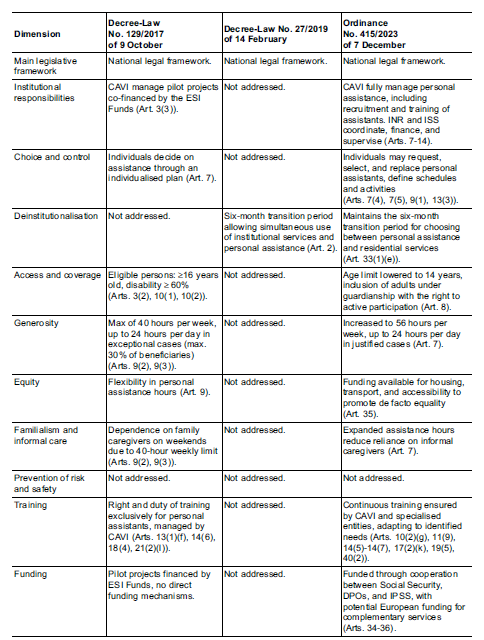
The legislative evolution of Portuguese MAVI/SAVI between 2017 and 2023 reveals a progressively consolidated framework and a gradual decentralisation of responsibilities. As summarised in Table 1, Decree Law No. 129/2017 established the model through Independent Living Centres [CAVI], while Ordinance No. 415/2023 expanded their remit to include the recruitment, training, and management of personal assistants, alongside formalised mechanisms for user participation—reinforcing autonomy, transparency, and accountability (Decree Law No. 129/2017, 2017; Ordinance No. 415/2023, 2023).
Table 1 Evolution of the legislative framework Portuguese MAVI (2017-2023)
Source: Own elaboration based on Decree Law No. 129/2017 (2017); Decree-Law No. 27/2019 (2019); and Ordinance No. 415/2023 (2023).
Coordination between the Institute for the Rights of Persons with Disabilities [IDiPD], the former National Institute for Rehabilitation [INR], and the Institute for Social Security [ISS] reflects an effort to involve disability organisations in service delivery.
Choice and control are legally guaranteed, with users entitled to select and replace assistants, participate in planning, and terminate services. The 2023 Ordinance strengthens these rights through feedback mechanisms and integration with other services—such as housing and transport—enhancing autonomy and reducing reliance on informal care (Ordinance No. 415/2023, 2023).
Deinstitutionalisation was introduced in 2019 via a six month transition period, but without a parallel housing programme, its impact remains limited to those without informal support (Decree-Law No. 27/2019, 2019; Ratzka, 2003). Between 2017 and 2023, eligibility expanded and assistance hours increased, improving equity and flexibility, particularly for users with complex needs.
Legislative evolution is also reflected in access and coverage: the age threshold is lowered from 16 to 14, and adults under guardianship gain the right to active participation. The generosity of the model increases significantly, rising from a maximum of 40 to 56 weekly hours, with the possibility of 24 hours per day in justified cases. This expansion reduces reliance on informal caregivers, particularly at weekends, and improves equity for users with complex needs.
The 2023 Ordinance also introduces equity measures, providing complementary funding for housing, transport and accessibility, bringing the Portuguese model closer to European practices that seek to guarantee equality of opportunity in practice, and not merely in law.
In the area of training, the 2017 framework provided only for the right and duty of training for personal assistants, managed by CAVI. In 2023, continuous training is strengthened, diversified and coordinated with specialised entities, responding to needs identified on the ground and contributing to the professionalisation of personal assistance.
Finally, funding evolves from pilot projects dependent on European funds (2017) to a stable model financed by Social Security in cooperation with disability organisations and IPSS, with the possibility of European funding for complementary services.
In sum, between 2017 and 2023, MAVI/SAVI evolved from an experimental model into a more robust, comprehensive system aligned with international Independent Living principles, although structural challenges persist — particularly in housing, risk prevention and the consolidation of equity mechanisms.
Main insufficiencies of MAVI/SAVI
Despite these advances, the legislative and operational architecture of MAVI/SAVI continues to exhibit several structural insufficiencies. These limitations are consistent with concerns raised in the literature, monitoring reports, and peer review.
Absence of formal mechanisms for risk prevention and safety
MAVI/SAVI legislation does not establish formal procedures for risk prevention, safeguarding, or emergency response. This gap is significant given the disproportionately high rates of domestic violence, relational dependency, and abuse experienced by disabled people (Dockerty et al., 2015). Ethical concerns—such as power asymmetries and vulnerability in personal assistance relationships—highlight the need for robust vetting procedures, safeguarding protocols, and crisis response mechanisms (Saxton et al., 2001; Shakespeare et al., 2017).
Evidence from the 2021 interim evaluation reinforces this diagnosis. The report highlights that many personal assistants operate in family environments where vulnerabilities such as relational dependency and domestic violence are more likely to arise (Dockerty et al., 2015). It also identifies instability in the availability of personal assistants and inconsistencies in the boundaries of personal assistance (Iscte, 2021). Taken together, these findings illustrate the need for formal and proportionate risk prevention mechanisms.
Lack of training and formal competence certification for users of personal assistance and their families
Although the 2023 Ordinance introduces continuous training for personal assistants, it does not extend this provision to users or families, nor does it offer any mechanism for formally recognising competences acquired through lived experience. This omission reflects persistent assumptions about passive user roles and the belief that personal assistance management skills are innate rather than learned (Ratzka, 2004; Vasey, 2000). It also contrasts with international practices in vocational education and training, where competence based certification is standard (International Labour Organization, 2020; Mulder, 2017).
Evidence from the 2021 interim evaluation reinforces this diagnosis: although personal assistants report general satisfaction with initial and complementary training, many express the need for broader and more specialised content (Iscte, 2021). By contrast, the evaluation report is silent on whether users or families should receive structured training or formal recognition of the competences they develop through the daily coordination of support arrangements. This omission, and the absence of proposals in this regard, appears to validate a version of MAVI/SAVI in which the authority of personal assistants is strengthened vis à vis beneficiaries, within a technocratic society that places high value on the formal recognition of competences.
Taken together, these findings strengthen the case for introducing competence recognition mechanisms inspired by vocational training systems, ensuring that both users and assistants are acknowledged as holders of valuable experiential knowledge.
An exclusively organisational funding model
Both the 2017 and 2023 regulations maintain an organisational funding model, channelling resources through CAVI rather than directly to users. This approach aligns with CRPD preferences for supporting civil society organisations (Convention on the Rights of Persons with Disabilities, opened for signature 30 March 2007, 2515 UNTS 3 (entered into force 3 May 2008), but diverges from Independent Living Movement principles, which advocate direct payments to individuals to maximise autonomy, flexibility, and control over support arrangements (Ratzka, 2017; Siegel et al., 2009).
The evaluation confirms that beneficiaries value the organisational model provided by CAVI, with a majority expressing satisfaction with the administrative, contractual and training support offered. However, it also reveals a consistent demand for more flexible hours and better alignment between allocated support and individual needs (Iscte, 2021).
Uneven territorial coverage and dependence on European funds
The expansion of MAVI has been uneven across regions, resulting in significant disparities in access and availability. This pattern is confirmed by the 2021 interim evaluation, which documents marked regional differences in access to personal assistance, reflecting the uneven distribution of CAVI and variations in organisational capacity. The report also highlights the model’s heavy dependence on European structural funds, raising concerns about long term sustainability and the ability to scale services nationally (Iscte, 2021). Taken together, these findings reinforce the structural limitations identified in this article and underscore the need for a more coherent, territorially balanced and financially stable framework for independent living in Portugal.
Limited articulation with IEFP, housing, and community services
Although these domains lie outside the formal scope of MAVI, the absence of structured coordination with employment services (IEFP, IP), housing programmes and community based supports limits the model’s ability to promote independent living in a holistic manner. This fragmentation reduces the effectiveness of personal assistance as a tool for social participation, labour-market inclusion, community integration and deinstitutionalisation (European Union Agency for Fundamental Rights [FRA], 2012; Mansell et al., 2007). Unfortunately, the 2021 interim evaluation report is also silent on this matter (Iscte, 2021).
Danger and uncertainty on the horizon: The prospect of a means-testing requirement
It should also be noted that the 2026 Portuguese State Budget introduces the possibility of applying a means testing requirement to future beneficiaries of MAVI/SAVI. Although not yet implemented, this measure represents a potential shift in eligibility criteria and has raised concerns among DPOs regarding its impact on equity and universality.
Rethinking the Portuguese independent living support model
In this section, we will examine practices from various sectors that, if adopted, could address institutional challenges and strengthen the Portuguese MAVI/SAVI. We begin with lessons from aviation safety, focusing on recruitment protocols and data systems relevant to personal assistance.
Risk prevention and safety: Lessons from the aviation sector
What is the praxis in this sector
The aviation sector has developed a highly structured system of risk prevention grounded in clear protocols, rigorous recruitment, continuous training, and permanent performance monitoring. Identity verification, psychological and physical assessments, alcohol and drug testing, criminal background checks, regular emergency procedure training, and incident reporting systems form part of a comprehensive safety culture designed to minimise human error in high-risk environments. As Appelbaum and Fewster (2003) note, this culture is sustained through systematic training and performance oversight, while Dismukes et al. (2007) highlight how aviation relies on tightly managed procedures to mitigate dependency and risk in complex operational contexts.
What MAVI/SAVI problem it helps address
This architecture offers valuable insights for MAVI/SAVI, which currently lacks formal mechanisms for risk prevention and safeguarding. Many personal assistants operate within family settings where vulnerabilities such as domestic violence, relational dependency and potential abuse are more likely to occur (Dockerty et al., 2015). Pinto and Kuznetsova (2019) emphasise that informal care arrangements often expose disabled people to heightened relational risks, making the absence of structured protocols particularly problematic. Without clear standards for recruitment, training and monitoring, the safety of both users and assistants remains contingent on individual circumstances rather than institutional safeguards.
How it could be adapted to MAVI/SAVI
Elements of aviation practice could be adapted to create a light and proportionate risk prevention system within MAVI/SAVI. Simplified identity and background verification procedures could be introduced without generating excessive bureaucracy. Periodic assessments of competences and well being—focused on relational skills, emotional resilience and ethical conduct—would help identify risks at an early stage. Continuous training in safety, communication and conflict management would mirror the aviation sector’s emphasis on regular skill reinforcement (Appelbaum & Fewster, 2003). In addition, data collection and information sharing mechanisms, with appropriate safeguards, could support incident monitoring and the improvement of practices, echoing the proactive safety culture observed in civil aviation.
Limitations and risks of transfer
It must be acknowledged that the nature of risks in civil aviation—operational, physical and safety critical—differs substantially from the social and relational risks present in personal assistance. For this reason, the aviation sector is used here as a conceptual illustration of how structured safeguarding mechanisms can be organised, rather than as a direct template for MAVI/SAVI.
Transferring these practices entails limitations and risks. If protocols are copied too literally, they may lead to unnecessary bureaucratisation or impose rigid procedures that undermine user autonomy—an issue central to the Independent Living Movement, which stresses that non disabled professionals “cannot have the insight into our needs, lifestyles and aspirations which we have” (Ratzka, 2017). Poorly designed assessments could stigmatise users or families, and safeguarding measures must remain proportionate to avoid transforming support relationships into relationships of control. Finally, implementing such mechanisms requires institutional capacity that MAVI/SAVI does not yet possess, particularly in relation to monitoring, evaluation and data management.
Direct payments: Lessons from CAP and STIP
What is the praxis in this sector
Direct funding mechanisms in the Common Agricultural Policy [CAP] and in Science, Technology and Innovation Policies [STIP] illustrate how financial instruments can simultaneously promote stability, personalisation and strategic alignment. This reflects broader shifts identified in neoinstitutionalist welfare literature, which distinguishes industrial era income protection regimes from post industrial models that prioritise activation, autonomy and the management of diffuse social risks (Armingeon & Bonoli, 2007; Bonoli, 2007; Häusermann et al., 2012). CAP achieves this through differentiated schemes and behavioural criteria, while STIP operationalises direct support through doctoral scholarships that combine predictable income with tailored resources for research development (Heitor & Horta, 2014; Jongbloed, 2019). These models demonstrate how direct payments can enhance autonomy and responsiveness without undermining institutional coordination.
The Portuguese system of doctoral scholarships provides a particularly relevant example. Host institutions do not receive a fixed administrative fee or discretionary overhead for welcoming a doctoral fellow. Instead, the FCT transfers funds earmarked exclusively for the direct costs of the work plan. Tuition fees—up to €2,500 per year—are paid directly to the higher education institution, while research units receive a modest annual allocation, typically €750, strictly to cover research related expenses such as conference participation, fieldwork, consumables or publication fees (Fundação para a Ciência e a Tecnologia, 2023). Crucially, individual doctoral grants do not include institutional overheads, distinguishing them from project based funding and reinforcing their purpose as personalised support instruments rather than organisational subsidies.
What MAVI/SAVI problem it helps address
The reference to doctoral scholarships does not imply that such instruments should be replicated in the field of independent living. Rather, it demonstrates that the Portuguese State already possesses technically robust mechanisms for transferring funds directly to individuals, thereby validating the feasibility of introducing flexible and personalised funding instruments within MAVI/SAVI. While many beneficiaries value the current organisational model, direct payments—where appropriate—would enhance autonomy and responsiveness in line with contemporary disability policy trends.
The interim evaluation shows that beneficiaries are generally satisfied with the current funding and organisational model, an arrangement that channels resources through the CAVI rather than allocating them directly to users. However, international evidence does not appear to be consistent with these results. The European study on deinstitutionalisation emphasises that autonomy depends on choice, control and the ability to decide how allocated resources are used (Mansell et al., 2007). Likewise, the FRA’s comparative study on independent living highlights the empowering role of personal budgets and direct payments, demonstrating that choice and control depend on access to different forms of support (FRA, 2012).
Moreover, as the interim evaluation does not indicate whether respondents had any experience in managing direct funding mechanisms, nor whether they received prior training for that purpose, the satisfaction expressed with the organisational model implemented in Portugal does not appear to rest on comparative grounds, since users have had no exposure to alternative funding arrangements. Thus, the satisfaction reported reflects above all the absence of alternatives, rather than a well informed choice between different support models.
At the same time, many respondents express a desire for greater flexibility and improved responsiveness to individual needs. Families similarly report that current support levels do not always match daily requirements (Iscte, 2021). These findings suggest that reliance on organisational funding — which tends to favour providers whose financing is guaranteed regardless of whether their offer adapts to users’ needs — restricts user autonomy when seeking support outside MAVI/SAVI, reduces flexibility in managing personal assistance services, and constrains the ability to adjust support, contract complementary provision or respond to unforeseen needs.
How it could be adapted to MAVI/SAVI
A solution more consistent with Independent Living principles would be to establish direct funding as the default option, complemented by an institutional alternative for those who prefer or require it. In a user choice model, each person could decide either to manage a flexible, user centred funding component — enabling personalised organisation of personal assistance — or to retain the existing organisational system. This approach does not replace the institutional model but repositions it as an available alternative, ensuring financial and operational control for those who wish to exercise it while preserving organisational mediation for users who value or need it. Hybrid arrangements of this kind are common in contemporary disability policy and reflect international trends that emphasise autonomy, choice and proportionality.
For this logic of choice to be viable, it is necessary to introduce flexible elements into the MAVI/SAVI funding structure, allowing users to adjust personal assistance within defined parameters. This flexibility should be anchored in each person’s Personal Individual Assistance Plan [PIAP], much like STIP scholarships are tied to individual research proposals. Funding could also incorporate behavioural or contextual criteria — such as participation in training, responsible management of support or additional needs — ensuring that resources respond simultaneously to personal circumstances and broader policy goals.
This framework is compatible with European models of multilevel governance. A system inspired by the CAP would ensure continuity of European funding while allowing regional adaptations without compromising national consistency (Fehér & Raicov, 2016; Laroche-Dupraz et al., 2023). Such an architecture could form the central pillar of a broader European convergence agenda in disability policy, centred on direct subsidies to promote independent living across the Union, while also preventing the scenario foreseen in the Portuguese State Budget for 2026, which introduces the possibility of means testing future MAVI/SAVI beneficiaries.
In parallel, the doctoral scholarship system administered by the FCT demonstrates how direct funding can coexist with institutional structures. In this model, doctoral candidates receive a monthly allowance for subsistence and research related expenses, tuition fees are paid directly to higher education institutions, and research units receive an allocation exclusively for research related costs (FCT, 2023). This arrangement preserves institutional responsibilities while granting individuals the flexibility needed to shape their own pathways — a logic aligned with broader analyses of personalised funding in research and innovation policy (Heitor & Horta, 2014; Jongbloed, 2019).
Adapting this logic to personal assistance would make it possible to design a hybrid model combining direct payments to individuals with an institutional component partially based on performance, should allocations to CAVI be indexed to indicators of inclusion and participation among supported users.
Limitations and risks of transfer
Such a transfer is not without risks. Confusion may arise between income support and funding for support management, which must remain clearly separated — an issue well documented in comparative analyses of direct payments (Arksey & Glendinning, 2007). Flexibility could exacerbate territorial inequalities if not accompanied by corrective mechanisms, echoing criticisms of CAP’s uneven distributive effects (Bojnec & Fertö, 2022; Dinis, 2023). Ensuring transparency and accountability is essential to avoid excessive administrative burdens, particularly for users with fewer resources or lower literacy levels. Finally, the success of such a model depends on institutional capacity to manage flexible systems and monitor outcomes effectively — capacities that remain uneven across regions and organisations, as highlighted by the interim evaluation (Iscte, 2021).
Recognition of competences: Lessons from the RVCC
What is the praxis in this sector
Within the framework of European policies for valuing human capital, the Vocational Training Sector [RVCC] system operationalises the validation of non-formal and informal learning without requiring traditional school attendance (European Centre for the Development of Vocational Training, 2012; Werquin, 2010). Centred on the profile of adults with consolidated work-based experience, the model legitimises competences acquired throughout life through holistic diagnostic and assessment tools: the compilation of reflective portfolios, biographical narratives, practical demonstrations and the modular capitalisation of Short-Duration Training Units (Cavaco, 2009; Gomes et al., 2006). This approach aligns with Independent Living Movement principles, which recognise disabled people as experts in their own support needs and reject models that privilege professional authority over lived experience (Ratzka, 2007; Vasey, 2000).
What MAVI/SAVI problem it helps address
The interim evaluation highlights that personal assistants often come from diverse professional backgrounds and acquire substantial competences through practice, yet these skills remain formally unrecognised (Iscte, 2021). Users and there’s families likewise develop significant managerial, relational and organisational competences through the daily coordination of support (Todd & Shearn, 1996a; Todd & Shearn,1996b), but the model provides no mechanism to validate this experiential knowledge. This gap reinforces a structural imbalance already identified in disability policy literature, where training provisions tend to focus on assistants while neglecting the learning needs of users and families—thereby reproducing hierarchical relationships that contradict Independent Living Movement principles (Ratzka, 2007; Vasey, 2000). These findings strengthen the case for a competence recognition framework inspired by RVCC principles, repositioning both users and assistants as holders of valuable, certifiable knowledge.
How it could be adapted to MAVI/SAVI
Adapting RVCC principles to MAVI/SAVI would require recognising that both users and personal assistants accumulate substantial experiential competences through daily practice. For users, these competences include coordination, communication, risk management, negotiation, planning and the ability to direct support — skills that are central to the Independent Living model but remain invisible in the current framework.
One way of operationalising this recognition would be to create a light, user led tutoring programme designed to strengthen the managerial and organisational competences required to direct personal assistance. Rather than formal training, this would function as a flexible support mechanism: short modules, peer to peer learning, mentoring by experienced users, and practical guidance on managing assistants, organising schedules, resolving conflicts, support management, communication, planning, decision making and navigating administrative procedures. Participation would be voluntary and tailored to each user’s Personal Individual Assistance Plan [PIAP], ensuring that the programme reinforces autonomy rather than imposing standardised expectations.
For assistants, recognition would focus on relational, organisational and task specific skills acquired through practice. This dual pathway would help rebalance the asymmetry identified in the interim evaluation, where training and formalisation tend to focus on assistants while neglecting the learning needs of users and families.
Such an adaptation would strengthen the MAVI/SAVI model by making visible the expertise that already exists within the system, improving consistency of practice, and reinforcing the principle — central to the Independent Living Movement — that disabled people are the foremost experts in their own support needs.
Limitations and risks of transfer
While the transfer of competence recognition mechanisms offers clear benefits, it also carries important risks that must be carefully managed. A central concern is the potential blurring of boundaries between income support and funding for support management, which must remain clearly separated — an issue well documented in comparative analyses of direct payments (Arksey & Glendinning, 2007).
Light, user-led tutoring programmes may also generate uneven participation if not accompanied by accessible formats and adequate peer support, particularly for users with fewer resources or lower literacy levels. Flexibility, if poorly regulated, could exacerbate territorial inequalities, echoing criticisms of the uneven distributive effects observed in CAP-inspired governance models (Bojnec & Fertö, 2022; Dinis, 2023).
Another risk concerns the professionalisation of personal assistants. As Ratzka (2007) emphasises, the Independent Living Movement rejects forms of professionalisation that shift authority away from users or impose standardised expectations about what a “typical” assistance relationship should look like. By contrast, the movement explicitly supports the professionalisation ofusers themselves, recognising that structured, proportionate training can strengthen their authority, enhance safety and reinforce the principle that users are the foremost experts in their own lives (Oliveira, personal communication, 19 April 2008).
The challenge, therefore, is not to avoid formalisation altogether, but to ensure that any recognition or certification remains light, voluntary, user-led and focused on empowerment rather than hierarchy.
Conclusion
This article has demonstrated that the persistent institutional challenges affecting the Portuguese MAVI/SAVI — specifically the absence of formal safeguarding, the rigidity of organizational funding, and the non-recognition of experiential expertise — can be productively addressed through policy transfer, translation, and institutional bricolage. Rather than advocating for the mechanical replication of external architectures, this study has used mature policy domains as conceptual reference points to design proportional, context-sensitive, and complementary solutions for the Portuguese independent living framework. These theoretical perspectives demonstrate that meaningful reform is not a linear process of importing external solutions, but a negotiated transformation shaped by institutional legacies, organizational routines, and political values.
As the model operated in its pilot phase between 2017 and 2023, institutional arrangements focused primarily on establishing basic operational structures under tight European funding constraints. This limited scope naturally restricted opportunities for broader cross-sectoral learning, favouring a minimal implementation logic centred on the day-to-day functioning of CAVI rather than on institutional learning or the translation of external solutions. However, as the model transitions into a consolidated national policy, the proposals developed in this study demonstrate that meaningful reform is both possible and conceptually grounded, offering a viable roadmap for incremental reform.
First, the adaptation of a safety culture inspired by civil aviation protocols provides a framework for a light, systematic, and proactive safeguarding system. By focusing on non-punitive, voluntary reporting of relational risks, this approach avoids professionalized policing or intrusive oversight in the private sphere. It strengthens protection for both personal assistants and users without undermining the user’s domestic sovereignty or personal autonomy.
Second, the proposed hybrid funding model does not seek to dismantle the established CAVI network, which beneficiaries highly value. Instead, drawing on lessons from direct payments in agricultural and scientific research policies, it introduces direct and flexible personal budgets as an optional pathway. This dual-track approach empowers users who require higher operational flexibility to manage their support independently, while maintaining institutional mediation and administrative support for those who prefer or need it, thereby allowing greater personalization without undermining overall system coherence.
Third, instead of introducing an entirely new educational framework, the translation of vocational training (RVCC) principles suggests a strategic integration with the existing national Qualifica system. By developing specific key-competence descriptors focused on independent living management, the state can formally recognize the highly complex, experiential expertise accumulated daily by both personal assistants and users. Recognizing the experiential competences of users rather than just assistants directly addresses power asymmetries, elevates the role of disabled people from passive service recipients to active co-producers of their support, and potentially reshapes how the very notion of professionalism is understood within the philosophy of this movement.
Finally, this study has limitations that must be acknowledged, as the exploratory analysis relies exclusively on secondary and secondary-legislative sources and does not incorporate interviews, observation, or empirical data on the everyday practice of personal assistance. To build a more robust evidence base, future research should examine the implementation of MAVI/SAVI in greater depth, pilot hybrid funding models, and empirically explore how users and assistants develop and mobilize experiential competences. Ultimately, embracing the logic of institutional bricolage offers a path to refine MAVI/SAVI, ensuring that its future development remains firmly anchored in the international principles of the CRPD and the Independent Living Movement, whilst remaining administratively feasible and responsive to the Portuguese context.
Acknowledgements
The author declares that the final version of the text was reviewed using Microsoft Copilot (version 1.25073.146.0).
Conflict of interest & ethics statement
The author declares no conflicts of interest. This study does not involve human participants, personal data, or interventions, and therefore does not require ethical approval or informed consent.
Data availability statement
No new data were created or analysed in this study. All data sources are publicly available and cited in the reference list.
Funding statement
This research received no specific grant from any funding agency in the public, commercial, or not-for-profit sectors.
Disclosure statement
The author declares no competing interests.
References
Appelbaum, S., & Fewster, B. (2003). Global aviation human resource management: Contemporary employee and labour relations practices. Management Research News, 26, 56-69. https://doi.org/10.1108/01409170310784069
Arksey, H., & Glendinning, C. (2007). Choice in the context of informal caregiving. Health &Social Care in the Community, 15(2), 165-175.
Armingeon, K., & Bonoli, G. (2007). The politics of post-industrial welfare states: Adapting post-war social policies to new social risks. Routledge.
Benson, D., & Jordan, A. (2011). What have we learned from policy transfer research? Dolowitz and Marsh revisited. Political Studies Review, 9(3), 366-378.
Bojnec, Š., & Fertö, I. (2022). Do different types of Common Agricultural Policy subsidies promote farm employment?. Land Use Policy, 112, 105823. https://doi.org/10.1016/j.landusepol.2021.105823
Bonoli, G. (2007). Time matters postindustrialization, new social risks, and welfare state adaptation in advanced industrial democracies”. Comparative Political Studies, 40(5), 495-520.
Cavaco, C. (2009). Adultos de Baixa Escolaridade e Aprendizagem: Trajetórias de Vida e Educação de Adultos. Instituto de Educação da Universidade de Lisboa.
Convention on the Rights of Persons with Disabilities, opened for signature 30 March 2007, 2515 UNTS 3 (entered into force 3 May 2008). https://www.ohchr.org/en/instruments-mechanisms/instruments/convention-rights-persons-disabilities
Decree Law No. 129/2017 of 9 October. (2017). Establishes the Independent Living Support Model (MAVI). Diário da República, 1st Series, No. 194, 5608-5618.
Decree-Law No. 27/2019 of 14 February. (2019). Amends Decree Law No. 129/2017 of 9 October, which estbalished the Independent Living Support Model (MAVI). Diário da República, 1st Series, No. 32, 1232-1233.
Dinis, I. (2023). Examining Disparities in CAP Direct Payments Among Farming Systems: Evidence from Portugal [Preprint]. Preprints.org. https://doi.org/10.20944/preprints202304.0683.v1
Dismukes, R. K., Berman, B. A., & Loukopoulos, L. D. (2007). The Limits of Expertise: Rethinking Pilot Error and the Causes of Airline Accidents. Ashgate Publishing.
Dockerty, C., Varney, J., & Jay-Webster, R. (2015). Disability and domestic abuse risk, impacts and response. Public Health England, 1-25.
Dolowitz, D. P., & Marsh, D. (2000). Learning from abroad: The role of policy transfer in contemporary policy-making. Governance, 13(1), 5-24.
Dunlop, C. A. (2009). Policy transfer as learning: Capturing variation in what decision-makers learn from epistemic communities. Policy Studies, 30(3), 289-311.
European Centre for the Development of Vocational Training. (2012). European Guidelines for Validating Non-Formal and Informal Learning. European Centre for the Development of Vocational Training. Publications Office of the European Union.
European Commission & Directorate-General for Employment, Social Affairs and Inclusion. (2021). Union of equality – Strategy for the rights of persons with disabilities 2021-2030. Publications Office. https://doi.org/doi/10.2767/31633
European Network on Independent Living. (1990). Principles of Independent Living. European Network on Independent Living.
European Union Agency for Fundamental Rights. (2012). Choice and control: The right to independent living. Experiences of persons with intellectual disabilities and persons with mental health problems in nine EU Member States. Publications Office of the European Union.
Fehér, A., & Raicov, M. (2016). Implementation of Common Agricultural Policy provisions on direct payments: Case study Romania. Review on Agriculture and Rural Development, 5(1-2), 92-103. https://doi.org/10.14232/rard.2016.1-2.92-103
Fundação para a Ciência e a Tecnologia. (2023). Regulamento de Bolsas Individuais de Doutoramento. Fundação para a Ciência e a Tecnologia.
Gomes, M. C., Umbelino, A., Martins, I. F., Oliveira, J. B., Bentes, J., & Abrantes, P. (2006). Referencial de competências-chave para a educação e formação de adultos – nível secundário: Guia de operacionalização. Direcção-Geral de Formação Vocacional. https://anqep.gov.pt/np4/344.html.
Häusermann, S., Bonoli, G., & Natali, D. (2012). The Politics of Old and New Social Policies. Oxford University Press.
Heitor, M., & Horta, H. (2014). Democratizing Higher Education and Access to Science: The Portuguese Reform 2006–2010. Higher Education Policy, 27(2), 239-257. https://doi.org/10.1057/hep.2013.21
International Labour Organization. (2020). Competency-Based Training (CBT): A training manual for TVET officials and developers. ILO Regional Office for Arab States.
Iscte. (2021). Avaliação Intercalar do Projeto Piloto do Modelo de Apoio à Vida Independente em Portugal. Iscte.
Jongbloed, B. (2019, August 25-28). Scholarships for PhD students: An interim evaluation of a Dutch policy experiment [Paper presentation]. 41st EAIR Forum 2019, Leiden, the Netherlands. https://research.utwente.nl/en/publications/scholarships-for-phd-students-an-interim-evaluation-of-a-dutch-po/
Laroche-Dupraz, C., Stéphane Lemarié, & Piet, L. (2023). Who (really) benefits from the complementary redistributive income support? EuroChoices, 23, 34-45. https://doi.org/10.1111/1746-692x.12418
Mansell, J., Knapp, M., Beadle-Brown, J., & Beecham, J. (2007). Deinstitutionalisation and community living – outcomes and costs: Report of a European Study (Vol. 1). University of Kent.
Marsh, D., & Sharman, J. C. (2009). Policy diffusion and policy transfer. Policy Studies, 30(3), 269-288.
Mukhtarov, F. (2014). Rethinking the travel of ideas: Policy translation in the water sector. Policy & Politics, 42(1), 71-88.
Mulder, M. (Ed.). (2017). Competence-based Vocational and Professional Education: Bridging the Worlds of Work and Education. Springer.
Oliveira, P. N. (2020). Vida independente: Potenciar o controlo e poder de escolha ao cidadão com deficiência. Revista de Educação Especial e Reabilitação, 27, 35-53.
Ordinance No. 415/2023 of 7 December. (2023). Establishes the conditions for the creation, organisation and operation of the personal assistance service under the Independent Living Support Model (MAVI). Diário Da República, 1st Series, No. 236, 91-107.
Pinto, P. C., & Kuznetsova, Y. (2019). Living independently and being included in the community – Portugal. Academic Network of European Disability Experts.
Porto de Oliveira, O. (2021). A prelude to policy transfer research. In O. Porto de Oliveira (Ed.), Handbook of policy transfer, diffusion and circulation (pp. 1-24). Edward Elgar Publishing. https://doi.org/10.4337/9781789905601.00007
Ratzka, A. (2003). The prerequisites for de-institutionalization [Conference presentation]. European Conference on Independent Living. Independent Living Institute https://www.independentliving.org/docs6/ratzka200304.html
Ratzka, A. (Ed.). (2004). Model National Personal Assistance Policy. Independent Living Institute. https://www.independentliving.org/docs6/ratzka200410a.html
Ratzka, A. (2007, October 22). Independent Living for people with disabilities: From patient to citizen and customer [Keynote address]. Conference commemorating the 25th anniversary of the Spanish Law for Persons with Disabilities, Barcelona, Spain.https://www.independentliving.org/docs7/ratzka20071022.html
Ratzka, A. (2017). Self-determination for Persons with Extensive Disabilities through Direct Payments for Personal Assistance. Independent Living —Institute. https://www.independentliving.org/docs7/Self-determination-direct-payments.html
Saxton, M., Curry, M. A., Powers, L. E., Maley, S., Eckels, K., & Gross, J. (2001). Bring my scooter so I can leave you”: A study of disabled women handling abuse by personal assistance providers. Violence Against Women, 7(4), 393-417. https://doi.org/10.1177/10778010122182567
Shakespeare, T., Porter, T., & Stöckl, A. (2017). Personal Assistance Relationships: Power, Ethics and Emotions [Report on ESRC Project ES/L007894/1.]. University of East Anglia.
Siegel, B., Bear, D., Andres, E., & Mead, H. (2009). Measuring equity: An index of health care disparities. Quality Management in Healthcare, 18(2), 84-90.
Stone, D. (2004). Transfer agents and global networks in the ‘transnationalization’ of policy. Journal of European Public Policy, 11(3), 545-566. https://doi.org/10.1080/13501760410001694291
Todd, S., & Shearn, J. (1996a). Struggles with time: The careers of parents with adult sons and daughters with intellectual disabilities. Disability Society, 11(3), 379-401.
Todd, S., & Shearn, J. (1996b). Time and the person: The impact of support services on the lives of parents of adults with intellectual disabilities. Journal of Applied Research in Intellectual Disabilities, 9, 40-60.
Vasey, S. (2000). The Rough Guide to Managing Personal Assistants. Independent Living Institute.
Werquin, P. (2010). Recognising Non-Formal and Informal Learning: Outcomes, Policies and Practices. OECD Publishing. https://doi.org/10.1787/9789264063853-en
Data de subissão: 02/03/2026 Data de aceitação: 20/07/2026
Notas
[1] Since 2023, the Portuguese Independent Living Support Model (formerly MAVI, now SAVI – Serviço de Apoio à Vida Independente (Independent Living Support Service)) has been renamed under Ordinance No. 415/2023. Throughout this article, the term MAVI/SAVI is used to reflect this legislative evolution.
[2] The literal translation of the Portuguese term “Centros de Apoio à Vida Independente” would be “Independent Living Support Centres”. However, to facilitate reader comprehension, this article will use the internationally recognised designation “Independent Living Centres”.
Autores: Pedro Nuno de Oliveira