
2025, n.º 37, e20253711
João Trocado da Mata
ROLES: Funding acquisition, Project administration, Supervision, Conceptualization, Data curation, Formal
analysis, Investigation, Methodology, Writing – original draft, Writing – review & editing
AFFILIATION: Iscte-Instituto Universitário de Lisboa, Departamento de História, Centro de Investigação e
Estudos de Sociologia (CIES-Iscte) e Observatório Português das Atividades Culturais (OPAC).
Avenida das Forças Armadas, n.º 40, 1649-026 Lisboa, Portugal
E-mail: joao.mata@iscte-iul.pt | ORCID: https://orcid.org/0009-0005-9106-5882
José Soares Neves
ROLES: Funding acquisition, Project administration, Supervision, Conceptualization, Investigation,
Methodology, Writing – review & editing
AFFILIATION: Iscte-Instituto Universitário de Lisboa, Centro de Investigação e Estudos de Sociologia
(CIES-Iscte) e Observatório Português das Atividades Culturais (OPAC).
Avenida das Forças Armadas, n.º 40, 1649-026 Lisboa, Portugal
E-mail: jose_soares_neves@iscte-iul.pt | ORCID: https://orcid.org/0000-0002-6472-4337
Miguel Ângelo Lopes
ROLES: Data curation, Investigation, Methodology, Writing – review & editing
AFFILIATION: Iscte-Instituto Universitário de Lisboa, Centro de Investigação e Estudos de Sociologia
(CIES-Iscte) e Observatório Português das Atividades Culturais (OPAC).
Avenida das Forças Armadas, n.º 40, 1649-026 Lisboa, Portugal
E-mail: miguel.lopes@iscte-iul.pt | ORCID: https://orcid.org/0000-0002-2163-4796
Andreia Nunes
ROLES: Conceptualization, Investigation
AFFILIATION: Iscte-Instituto Universitário de Lisboa, Centro de Investigação e Estudos de Sociologia
(CIES-Iscte). Avenida das Forças Armadas, n.º 40, 1649-026 Lisboa, Portugal
E-mail: afrns1@iscte-iul.pt | ORCID: https://orcid.org/0000-0002-8429-424X
Abstract: This article examines gender differences in book reading for pleasure among students in primary and secondary education in Portugal, based on a representative sample comprising over 20,000 pupils. Drawing on concepts of socialisation and reading practices, the study analyses how the main agencies of socialisation shape the differentiated relationships that boys and girls develop with reading. The research adopts a quantitative methodology, combining descriptive statistical analysis, odds ratio and cluster analysis to map the distribution of practices and associated dispositions. The findings show that gender differences emerge early and become more pronounced throughout compulsory schooling. However, these differences are significantly reduced and statistically insignificant among avid readers, suggesting the importance of intensive socialisation trajectories characterised by early, sustained, and multifaceted exposure to reading. The article thus contributes to an understanding of reading practices as the product of socially constructed dispositions, revealing the persistence of gendered cultural differences even within contexts marked by plural affiliations and multiple agencies of socialisation.
Keywords: book reading practices, gender differences, socialisation, compulsory education students.
Resumo: Este artigo analisa as diferenças de género nas práticas de leitura de livros por prazer dos alunos dos ensinos básico e secundário em Portugal, a partir de uma amostra representativa que inclui mais de 20.000 discentes. Com base numa abordagem dos conceitos de socialização e de práticas de leitura, o estudo examina o modo como as principais instâncias de socialização influenciam a relação diferenciada de rapazes e raparigas com a leitura. Recorre-se a uma metodologia quantitativa, combinando análise estatística descritiva, razão de probabilidades e análise de clusters, para captar a distribuição das práticas e as disposições associadas. Os resultados mostram que as diferenças de género emergem precocemente e acentuam-se ao longo da escolaridade obrigatória. No entanto, estas clivagens são fortemente atenuadas, perdendo significância estatística, no grupo dos grandes leitores, o que sugere a importância das trajetórias de socialização intensiva e de percursos marcados por uma exposição precoce, continuada e multifacetada à leitura. O artigo contribui assim para o entendimento das práticas de leitura como produto de disposições socialmente construídas, revelando a persistência de diferenças culturais de género mesmo em contexto de pluralidade de pertenças e agências socializadoras.
Palavras-chave: práticas de leitura de livros, diferenças de género, socialização, alunos do ensino básico e secundário.
Introduction
Contemporary Western societies have increasingly been characterised by marked structural and functional differentiation (Parsons, 1971) alongside growing identity fragmentation resulting from the multiplicity of circles of belonging (Giddens, 1991; Simmel, 2009), the fluidity of social relations (Bauman, 2000), and the plurality of socialisation agencies transmitting heterogeneous and often contradictory dispositions (Lahire, 2003). Despite this multiplicity of affiliations and forms of socialisation, gender cleavages in cultural reading practices have not been eliminated. Research conducted over recent decades (Cameira, 2022; Donnat, 2005; Lages et al., 2007; Neves, 2011; Mata et al., 2020, 2021; Mata et al., 2025; Octobre, 2005) continues to highlight a persistent trend towards the feminisation of these practices, underscoring both the continuity and, in some cases, the intensification of gender asymmetries.
The study of reading practices therefore remains a privileged field for examining how socialisation agencies reinforce, legitimise, or weaken the symbolic value of reading, thereby contributing to differentiated practices and orientations among girls and boys, even within contemporary contexts marked by increasingly plurality, fluidity, and social differentiation.
This article adopts an approach grounded in the sociology of reading, articulating cultural reading practices with processes of socialisation and the differentiated internalisation of dispositions. It seeks to clarify how socialisation agencies (family, school, and peers) transmit forms of relating to reading shaped by gender[1] and social class, thereby contributing to the production and reproduction of significant social cleavages.
The research examines differences in book reading practices among girls and boys in primary and secondary education in mainland Portugal, using cross-sectional data from study Students’ Reading Practices in Portugal (PLEP) (Mata et al., 2020, 2021), a large-scale survey involving over twenty thousand pupils. By comparing groups across educational levels and stages, the analysis provides an approximate understanding of when gender differences become visible or tend to intensify throughout compulsory schooling.
The article is structured as follows: it begins with a review of the literature on reading practices, socialisation, and the social construction of gender differences, with particular attention to the role of socialisation agencies in differentiating practices and shaping dispositions towards reading. This is followed by the presentation of the methodological strategy, including the study design and sample. The third section discusses the main empirical findings, combining the analysis of indicators of reading practices with odds ratio estimates to identify statistically significant gender asymmetries across educational levels. It also introduces a typology derived from cluster analysis, which allows for the identification of distinct profiles of relationships with reading and an examination of their distribution by gender and agencies of socialisation. The article concludes by summarising the main findings and outlining directions for future research.
Reading for pleasure practices
The article adopts the concept of reading for pleasure as a cultural practice (Bourdieu & Chartier, 1993), aligning with an established body of research on the reading habits of pupils in primary and secondary education (Baudelot & Cartier, 1998; Clark & Rumbold, 2006; Clark & Teravainen, 2017; Cremin, 2007, 2020; Cremin & McGeown, 2025; Kucirkova & Cremin, 2020; Mata et al., 2025; Merga, 2021; OECD, 2002, 2010, 2019a, 2019b). The concept refers to forms of reading motivated by the reader’s own interest and is frequently described in the literature as leisure reading (Schüller et al., 2016), recreational reading (Melo, 2020; Pennington & Waxler, 2018; Ross et al., 2006, 2018); reading for enjoyment (OECD, 2002, 2010, 2019a, 2019b), volitional or free voluntary reading (Clark & Rumbold, 2006; Krashen, 2004; Kucirkova & Cremin, 2020), or even personal reading (Baudelot & Cartier, 1998). Within this conceptual diversity in the specialised literature, reading for pleasure is characterised by the mobilisation of the reader’s agency, as a cultural practice that tends to escape the logic of institutional prescription. Nevertheless, this agency is socially shaped and should therefore be analysed within the framework of the influences exerted by different institutions of socialisation.
Despite intersections between school time and free time, as well as between the different motivations that may lead to reading (Segré, 2001), this article considers, for operational purposes, reading for pleasure as an activity not directly linked to school curricula or to school-related reading activities. It is thus regarded as an autonomous practice, situated outside formal school requirements and marked by the reader’s individual choice (Ariño Villarroya, 2010, p. 92), even when it takes place in institutional contexts such as schools or libraries. The concept is distinguished from processes of decoding and textual comprehension (Kucirkova & Cremin, 2020), although the interdependence between reading for pleasure and reading skills should be recognised (Cremin & McGeown, 2025), particularly regarding the role of dispositions, competencies, and resources in the production of meaning and enjoyment (Mata et al., 2025).
Finally, reading for pleasure is resistant to approaches that frame reading predominantly in instrumental terms (Cameira, 2022; Lopes & Antunes, 2001; Monge & Quesada, 2019), whether utilitarian or pragmatic, and centred on the acquisition of technical skills or on the attainment of school outcomes. In this perspective, the formats or media of reading (print or digital) lose analytical relevance when compared with motivations and experiences associated with leisure-time reading (Mata et al., 2025).
The social construction of gender differences
The assertion that gender differences are socially constructed, together with the rejection of essentialist explanations, is broadly consensual within sociological theory (Baudelot & Establet, 2007; Bourdieu, 1990, 2005; Giddens, 1992; Goffman, 1977; Lahire, 1998, 2001, 2006; Octobre, 2005; Parsons, 1959), and constitutes a common denominator across diverse theoretical perspectives. Sex categories are understood as products of social and historical processes rather than biological determinism (Giddens, 1992), although they are frequently naturalised in everyday experience (Bourdieu, 1990, 2005; Goffman, 1977). As Lahire notes, “among the various categories that the social sciences traditionally use in their research, sex categories (together with age categories) are usually the most naturalised” (Lahire, 2001, p. 9), highlighting their deep-rooted nature and resistance to problematisation.
The concept of gender underlines the relational, historical, and symbolic character of these differences, and can be defined as a psychological, social, and cultural construct, emphasising that many of the differences between men and women are not of biological origin (Giddens, 1992, p. 158). Gender refers to historically constructed and potentially hierarchical social relations that vary over time and space, rather than merely to individual attributes. It also involves the social production of meanings, expectations, values, and representations that structure the practices associated with masculinity and femininity.
The construction of these differences is attributed to socialisation, a central concept in the sociological tradition that has attracted renewed interest and revitalisation in recent decades (Abrantes, 2011; Abrantes et al., 2024; Guhin et al., 2021). Sociological explanations for gender differences are grounded in diverse perspectives on the role of socialisation. This article draws on contributions from authors associated with different theoretical traditions (particularly functionalism, social reproduction, and social dispositions) with the aim of developing a broad and critical understanding of how differences are produced and reproduced in the reading practices of girls and boys. This theoretical diversity also reflects the multidimensional nature of socialisation, which involves structures, dispositions, and practices within contexts shaped by gender relations.
Socialisation, internalisation of commitments, and gender roles
In functionalist theory, socialisation fulfils the function of developing in individuals both commitments (the internalisation of general societal values and of one’s role within the social structure) and the capacities required to perform adult roles (competence and conformity with expectations). The family and the school, particularly the classroom group, act as the main agents of socialisation during childhood and adolescence. Parsons (1959) argues that the family is the principal socialising agency until the child enters school. Within the family status is attributed according to biological position (generation, sex, and age). It is a hierarchical structure that transmits the affective and symbolic matrix for gender differentiation, socialising the child into the gender role—the sole fundamental feature for future roles determined within the family. Upon entering school, the class group becomes the dominant socialisation agency, orienting pupils towards achievement criteria (merit and performance) that transcend gender roles. However, sex segregation within peer groups—which partly replace the family as the primary object of emotional dependence during primary education—reinforces identification with gender roles. Intensive association with same-sex peers and participation in gender-associated activities contribute to strengthening the sense of group belonging and accentuating contrasts with the opposite sex.
Parsons’ analyses shows that both primary and secondary socialisation inculcate gender roles, shaping the ways in which boys and girls position themselves in relation to school and cultural practices. The alignment between family, school, and peer socialisation is particularly cohesive in the case of girls, reinforcing expectations associated with the performance of the feminine role (especially the valorisation of schooling). Consequently, reading is more readily appropriated by girls, whose socialisation promotes continuity with school values, reinforced by the feminisation of the teaching profession.
Dispositions, habitus, and the symbolic reproduction of gender differences
The functionalist perspective on socialisation has been increasingly criticised for its normative determinism, conceptualising male and female roles as mechanisms of social integration. Pierre Bourdieu argues that “it is necessary to abandon all theories which explicitly or implicitly treat practice as a mechanical reaction, directly determined by the antecedent conditions and entirely reducible to the mechanical functioning of pre-established assemblies, ‘models’ or ‘roles’” (Bourdieu, 2013, p. 73) Building on this premise, a critical approach grounded in a dispositional model is developed, interpreting social reproduction through the concepts of habitus and the overall volume of capital. The notion of habitus seeks to overcome the limitations of the concept of socialisation and has achieved great prominence in social theory in the last decades of the twentieth century. Defined as “a system of lasting, transposable dispositions which, integrating past experiences, functions at every moment as a matrix of perceptions, appreciations, and actions” (Bourdieu, 2013, pp. 82-83), the concept asserts that social structures are embodied and internalised by individuals, becoming modes of action. Habitus is produced within a three- dimensional social space, which comprises the volume of capital, the structure of capital, and individual trajectories. The primary differences that distinguish major classes of conditions of existence are rooted in the overall volume of capital: economic, social, and cultural (Bourdieu, 2005, p. 114). Cultural capital—which exists in three states (Bourdieu, 1979a, p. 4): embodied (dispositions, knowledge, skills, and acquired tastes), objectified (books or works of art), and institutionalised (diplomas and educational credentials)—is transmitted through socialisation, a process initiated in the family home, the central locus of social reproduction and symbolic legitimation of the established social order (Bourdieu, 1993, p. 35).
The family, as the primary site for inculcation of habitus, transmits a “sex ethos” (Bourdieu, 1979b, p.90), that is, socially constructed dispositions regarding what is considered appropriate for girls and boys. These dispositions are “the product of the internalisation of the division of labour between the sexes as it is realised within a given social class, which also contributes to orienting investments, inclining, for example, girls towards literary and artistic studies and boys towards scientific or economic and legal studies (Bourdieu, 1979b, p. 90)[2] . This logic, which guides differentiated pathways and symbolically legitimates this division, assigns to women the function of conserving cultural capital and to men the representation of new culture, oriented towards innovation, action, and power (Bourdieu, 2005, p. 315).
The concept of a “sex ethos” helps to explain the association of book reading with the symbolic feminine universe, which is reflected in girls’ greater exposure to and investment in reading both at home and at school, and in boys’ tendency to reject practices perceived as feminine—such as reading fiction or poetry—within the school context. Girls are socially authorised to express sensitivity and introspection, whereas boys are encouraged to engage in practices more closely associated with objectivity and rationality.
From this perspective, the school contributes to the reproduction of the symbolic order of gender by naturalising the sexual division of labour. The function of conserving cultural capital also reinforces girls’ proximity to the school universe. Thus, the school institution does not actively impose gender difference, but rather reinforces dispositions that have already been internalised, particularly throughout school transitions (choice of study areas, curricular differentiation, vocational guidance) (Bourdieu & Passeron, 1964, 1978).
Dispositional plurality, socialisation, and gendered cultural practices
Bourdieu’s approach has paved the way for perspectives that, while maintaining the centrality of social dispositions, emphasise their heterogeneity and variability, in contrast to the idea of a unified and coherent habitus. Bernard Lahire (2003) highlights the plurality of individuals’ dispositions, resulting from their exposure to multiple socialisation agencies whose principles are often contradictory. This diversity in loci of transmission of dispositions may be interpreted as an effect of the process of structural differentiation in modern societies (Parsons, 1971), which has intensified institutional specialisation and increased the number of social circles (Simmel, 2009) in which children and adolescents participate, shaping their individuality and fragmenting their frameworks of belonging. A similar idea is present in Giddens’s (1992): the existence of diverse socialising agencies leads to divergences between the perspectives of children, adolescents, and the parental generation. However, despite variations in family structures, parental availability, and the time spent with children, the family generally remains a central agency of socialisation from childhood into adolescence and even beyond, as part of a developmental sequence linking generations (Giddens, 1992, pp. 76-77). This centrality is also highlighted by Lahire (2019), who conceives the family as a mediating instance between multiple socialisations, performing a filtering function in relation to the diversity of influences to which individuals are exposed.
According to Lahire, in highly differentiated societies, children are exposed to a wide range of socialising agents (family, nanny, nursery, kindergarten, school, study centres), which transmit norms, values, and expectations that are frequently at odds with one another (Lahire, 2003, 2005, 2019). However, not all dispositions acquired display the same durability, flexibility, or resistance to change. As Lahire affirms,
Ultimately, gendered forms of socialisation (and their effects) are those that are statistically most likely to correspond to the model of habitus. (…) Masculine and feminine dispositions are not experienced as one choice among other possible options, but rather as an evident necessity. Gendered social dispositions (or habits) are thus those that most closely correspond to the permanent, omnipresent, and transversal dispositions described by habitus theory (Lahire, 2001, pp. 12-13).
These dispositions tend to be experienced as internal necessities rather than external impositions, inhibiting detachment from gender roles and contributing to the persistence of differentiated (cultural) practices between boys and girls. This early internalisation is particularly visible in the sphere of cultural and reading practices, with the family, as suggested by Octobre (2005), functioning as the “first factory of gender”, acting as a space for the early differentiation of tastes, exposure to legitimate culture, and the incorporation of gendered models of socialisation.
In this article, socialisation is understood as a relational, reflexive, and dynamic process, involving multiple agencies whose influence is unequal, transmitting plural dispositions appropriated and internalised by individuals. The concept diverges from normative and functionalist readings and is mobilised here to understand the differentiated formation of reading dispositions, with particular attention to the interplay between social structures and everyday practices. This approach recognises the existence of structural constraints and the persistence of gendered dispositions, as well as the diversity of trajectories and the possibility of selective and counter-hegemonic appropriations. As Lahire (2019) argues, although children are, from an early age, particularly dependent on the adults to whom they are attached, especially the family, and their spheres of action and reaction are shaped by these bonds, they are not passive actors; they possess autonomy to engage in selective appropriations and differentiated enjoyment.
Reading practices and gender differences: contributions from empirical research
The analysis on reading practices among school-age population from international large-scales studies (PISA, PIRLS, and National Literacy Trust) reveals a structural difference in book reading that is large insensitive to the indicators used: girls enjoy reading more, read more books than boys and devote more time to reading for pleasure (Clark & Picton, 2020; Clark & Rumbold, 2006; Clark & Teravainen-Goff, 2020; Mullis et al., 2023; OECD, 2010, 2019b, 2021). This difference is also observable among students in Portugal (Lages et al., 2007; Mata et al., 2020, 2021; Mata et al., 2025). These studies, particularly PISA, have also revealed significant differences in attitudes and orientations between boys and girls: reporting book reading as a favourite pastime and enjoyable activity is more frequent among girls, whereas boys tend to describe their reading as imposed and/or instrumental in nature, and display even greater disinterest in reading (Clark & Akerman, 2008; Clark et al., 2008; Mata et al., 2021; OECD, 2019b; 2021).
To understand these persistent differences, the literature emphasises the role of socialising agencies in shaping reading dispositions and practices. Attention is therefore directed to the relations, dynamics and expectations within these mediating contexts, which help consolidate differentiated orientations towards reading.
Within primary socialisation, several authors have highlighted the need to take family dynamics into account as explanatory factors for reading practices: the family’s relationship with reading (Cameira, 2022; Lahire, 2008; 2019; Mata et al., 2020; 2021; Octobre, 2005) and the ways in which reading encouragement is reproduced across generations (Santos et al., 2007, pp. 210-212). Drawing on a large-scale survey[3] of French children’s cultural consumption, Octobre (2005) shows that girls, from a very early age, are more exposed to culturally legitimised activities such as reading and artistic practice, and display greater familiarity with formal cultural institutions (libraries, art workshops). The author interprets this precocity as the combined effect of three factors: the social categorisation of cultural activities (with the most legitimate ones associated with femininity), the gendered division of educational tasks within the family (with mothers playing a central role), and children’s active incorporation of gender roles. This early incorporation of a “female cultural habitus”, according to the author, helps explain girls’ stronger adherence to reading practices and their early autonomy in relation to this activity. As Octobre summarises: “Girls and boys are not equal in terms of the expression of tastes, because parents do not orient them towards the same activities and because, in the sphere of leisure, parental models—those of the mother and the father—shape children differently depending on whether they are girls or boys”. (Octobre, 2005, p. 2). This framework contributes to a refined understanding of socialisation processes, articulating family structures, gender representations, and everyday practices. Octobre’s analysis aligns with more recent studies conducted in other national contexts that identify early and gender-differentiated trajectories of involvement with reading, shaped by the combined action of family, school, and cultural agencies (Merga & Roni, 2018a; Scholes, 2020).
It is now relatively consensual that girls receive more encouragement to read than boys from parents and teachers, as a result of diverse family and school socialisation patterns that transmit distinct social roles and professional expectations and, in doing so, reproduce gender stereotypes, a central finding in several studies (Encinas-Martín & Cherian, 2023; Eloy et al., 2020; Muntoni & Retelsdorf, 2018; 2019; Nunes, 2019; OECD, 2019a, 2019b; Tepper, 2000). Parents who consistently encourage reading contribute to the formation of lifelong readers (Merga, 2014a), reinforcing the influential role of parents in fostering a lasting love of reading (Merga & Roni, 2018a). Studies have also found that parental behaviours related to leisure reading exert a stronger impact on daughters’ reading habits (Wollscheid, 2014). Although boys read less frequently, girls receive more encouragement, potentially reinforcing and perpetuating gender differences in reading frequency (Merga & Roni, 2018b). Moreover, research testing the gender-stereotype hypothesis has shown that fathers have a stronger impact on sons’ reading behaviour, while mothers exert an even stronger influence on daughters (Wollscheid, 2014).
In turn, the influence of peers and friends, as contexts and agents of socialisation, tends to increase during adolescence (Giedd, 2012, as cited in Merga, 2014b), and this phenomenon may be associated with a decline in the influence of the family. Although peers and friends are often treated as equivalent, research in this field reveals notable differences regarding their influence: friends have a stronger impact on reading choices (Hopper, 2005; Howard & Jin, 2007; Mansor et al., 2012, as cited in Merga, 2014b) as well as on reading habits. Merga (2014b) identifies a positive correlation between adolescents’ attitudes and their perceived attitudes of friends: the more adolescents perceive that their friends enjoy recreational book reading, the more favourable their own attitude towards this practice tends to be. However, the strength of this correlation varies by gender. Among boys, the correlation is moderate, whereas among girls it is weak. These results indicate a greater alignment between boys’ dispositions and those of their friends, while girls display a more autonomous stance in relation to friendship circles, which is particularly significant in contexts where reading is devalued. Analysis of data on sources of encouragement to read shows that girls receive more stimulation from friends: 25% report being encouraged by them, a figure that contrasts with what is observed among boys (11%).
While broadly distinguishable representations of book reading can be identified among boys and girls—greater devaluation among boys and greater appreciation among girls (Clark & Akerman, 2008; Clark et al., 2008)—this does not imply boys have an innate disinterest in book reading (Scholes, 2017a) nor that groups of avid male readers do not exist. Many boys find pleasure and meaning in the stories they read, identify with them, develop literary skills, and broaden their understanding of the world (Scholes et al., 2021). Treating boys and girls as homogeneous categories tends to oversimplify analysis, promoting generalisation and obscuring the multiplicity of social groups encompassed within each category (Scholes, 2015).
The analysis of gender differences in reading practices is therefore more complex. Although girls value the social aspects of reading more highly (Scholes, 2019a)—partly as a result of the impact of masculine social constructions on boys’ attitudes towards reading, which suggests the importance of challenging these constructions in order to promote positive reading experiences for boys (Scholes, 2017a, 2017b)—this does not mean that all groups of girls value or engage in reading in the same way. Reading practices and preferences are shaped by social expectations, group dynamics, and cultural norms, which may create barriers to active engagement with reading (Scholes, 2021).
Boys’ relationship with reading, similarly to girls’, can be affected by diverse influences such as family dynamics, peer interactions, and school environments; promoting positive engagement requires support, encouragement, and relevance to boys’ interests and identities (Scholes, 2019b). Boys’ reading identities are also shaped by factors such as social class, cultural context, and the diversity of masculinities they may embody (Scholes, 2020). Understanding how these dimensions interlink and impact boys’ reading experiences reveals that their preferences are more diverse and mutable than previously recognised (Scholes et al., 2021). Boys’ and girls’ positioning towards reading for pleasure can thus be understood as a product of socialisation that attributes values and meanings to reading as leisure, stemming from exposure to influential social agents such as parents, teachers, friends, and peers (Merga, 2014a; Merga, 2014b).
Methodology
The statistical data analysed in this article were produced within the framework of the study Students’ Reading Practices in Portugal (PLEP) (Mata et al., 2020, 2021), conducted between 2019 and 2021[4] .
The study adopts a quantitative, large-scale methodology based on a survey questionnaire administered to a representative sample of students enrolled in primary and secondary education in mainland Portugal. The research design is cross-sectional, collecting data from different groups of students at a specific point in time, without following the same individuals longitudinally.
Data collection was organised around four educational stages, for which three age-adapted questionnaires were developed: primary education (Grades 3-4); primary education (Grades 5-6); and a single questionnaire covering both lower secondary education (Grades 7-9) and upper secondary education (Grades 10-12). These questionnaires were designed to accommodate students’ ages, cognitive development, and symbolic universe.
Data collection began in 2019 with the survey operation targeting students in lower and upper secondary education. Data for the primary education were collected in 2021, following delays caused by the COVID-19 pandemic.
The surveys were administered in classes selected according to predefined stratification parameters, established by the research team and detailed below. Students completed the questionnaires in computer-equipped rooms using an electronic platform, under the supervision of a teacher (usually the school librarian teacher), and in accordance with a Fieldwork Manual. Participation required explicit parental consent.
The sampling procedure for each educational level was based on three stratification criteria: region (NUTS II), urban area typology, and type of educational institution (public or private schools). Table 1 presents the sample distribution by level of education and type of institution. In total, 20 296 students participated in the study (Mata et al., 2020, 2021).
Table 1 Sample of students by level of education and by type of educational institution
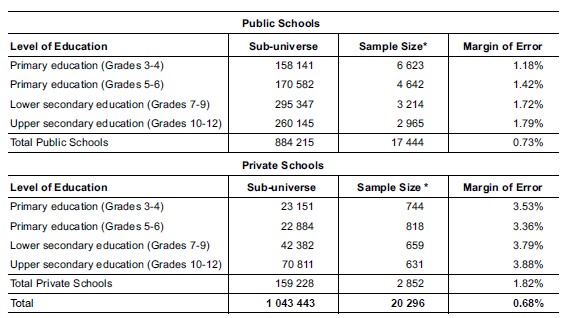
Note *: The survey of students in primary education was conducted in 2021.
Source: DGEEC (2019, 2021); CIES-Iscte (2019) (PLEP, lower secondary education and upper secondary
education); CIES-Iscte (2021) (PLEP, primary education).
Given that reading practices presuppose prior learning processes—namely the acquisition of basic reading and text comprehension skills in the early years of schooling—students in the 1st and 2nd grades were excluded from the analytical sample.
The assessment of gender differences in reading practices across the stages and levels of education that comprise compulsory schooling was carried out using the odds ratio, a measure employed to gauge the strength of the association between binary variables and to indicate the likelihood of a given event occurring between groups[5] . This measure was chosen because it is “not sensitive to the magnitude of rate or percentage values, thus fitting the comparative evolution of event occurrence with different starting points” (Merle, 2009, p. 63). It is therefore well suited to the analysis of social divides in educational and cultural contexts.
The variable “sex” (female/male), as collected in the questionnaire, was used to evaluate gender differences in reading practices, which were measured through the following variables, transformed into dichotomous (yes/no) variables for analytical purposes:
- Books read in the last 12 months;
- Time spent on reading—more than 30 minutes;
- Reading books at the time of the survey (originally dichotomous).
Subsequently, gender differences were analysed within book reader groups, corresponding to the “type of reader” (see note to Table 3 with quantitative specifications of types). To enable the application of the odds ratio, this variable was also transformed, resulting in three dichotomous variables (yes/no):
- Occasional;
- Moderate;
- Avid.
The current research also sought to explore students’ dispositions towards reading based on their stance regarding a set of statements. The evaluation of responses to these statements provides insight into how reading is perceived and valued, as an observable and measurable manifestation of socially shaped dispositions that structure individuals’ relationships with this activity. For this purpose, an exploratory multivariate approach was undertaken, centred on cluster analysis. This procedure was guided by the identification of profiles of relationship with reading, based on combined response patterns to five statements:
- Reading is one of my favourite pastimes;
- I like talking to others about books;
- I only read if I am forced to;
- Reading is a waste of time;
- I only read to find information I need.
Responses to the statements were measured on a four-point Likert scale (0 = “Strongly disagree”; 1 = “Disagree”; 2 = “Agree”; 3 = “Strongly agree”). The internal reliability of the set of items was evaluated using Cronbach’s Alpha, with the value obtained (a = 0.820) indicating high internal consistency. The correlation matrix confirmed the coherence of the measurement process, validating the joint use of the five items as a single block of variables for typological segmentation (profiles of relationship with reading).
Cluster analysis was performed in two phases. In the first phase, a hierarchical method (Ward’s method, with squared Euclidean distance) was used to explore the structure of the data and determine the optimal number of clusters, based on dendrogram inspection and variance evaluation. The choice of Ward’s method is grounded in its capacity to maximise internal homogeneity within each cluster and heterogeneity between groups, generating statistically robust and easily interpretable solutions. As some authors note, Ward’s method yields the most homogeneous clusters and the best separation between clusters in SPSS Statistics (Marôco, 2021, p. 532). This property makes it particularly suitable for identifying consistent dispositional profiles in ordinal data, such as responses to agreement scales. The analysis indicated a four-cluster solution with both statistical and interpretative coherence. In the second phase, the K-means method (IBM SPSS 29) was applied, using the four identified clusters to optimise case classification into cohesive and comparable groups.
After cluster formation, a cross-tabulation analysis was conducted with the variables “sex” and “level of education” to verify the existence of significant differences in the distribution of profiles of relationship with reading. This procedure further deepened the study of gender divides across school levels previously identified in the descriptive phase, strengthening the analysis of dispositions towards reading. Subsequently, the profiles of relationship with reading were examined in articulation with different socialisation contexts, aiming to clarify how these agencies contribute to reinforcing, reconfiguring, or distancing reading practices according to the identified profiles.
Finally, it is important to note that a significance level of 1% (a = 0.01) was adopted in evaluating gender differences (Tables 2 to 6). This decision aims to reduce the risk of statistical overinterpretation, considering that in large samples (such as in this study), very low p-values are commonly obtained even for weak associations, given that significance tests (such as chi-square) are sensitive to sample size.
Results
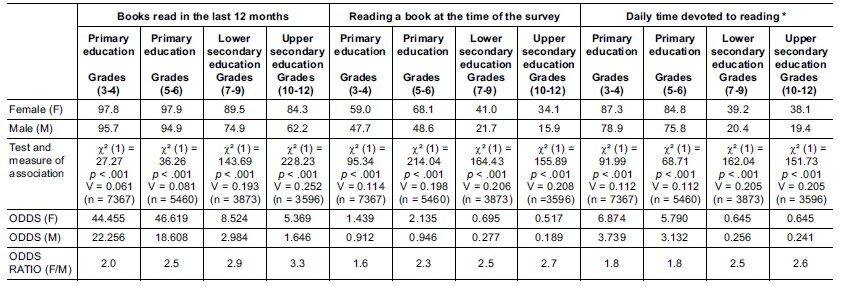
The evaluation of gender differences in reading practices begins with the use of three indicators: books read in the last year, reading at the time of the survey, and daily time devoted to reading, segmented by sex and level of education (Table 2). The statistical data reveal two clear and consistent trends: girls present higher values than boys across all indicators and educational stages, and reading levels show an overall decrease as students’ progress through the education system.
Table 2 Books read in the last year, at the time of the survey, and daily time devoted to reading by level of education and sex
(percentage of “yes” responses, odds ratio, and test and measure of association)
Notes:
i) * The measured daily time devoted to reading refers to 30 minutes or more. In primary education, time devoted to reading is restricted to books and school days. In lower and upper secondary education, the time devoted to reading includes various types of reading materials, such as books, magazines, newspapers, webpages, blogs, emails, and so forth.
ii) The data are based on responses to the following questions: For primary education: “How many books, approximately, did you read in the last year, not including school textbooks?”; “Are you currently reading any book?”; “On a typical school day, how much time do you spend reading books (excluding school textbooks)?”. For lower and upper secondary education: “How many books, approximately, did you read for pleasure over the past 12 months?”; “Are you currently reading any book for pleasure?”; “On average, how much time do you usually spend reading for pleasure?”.
Source: CIES-Iscte (2019) (PLEP, lower and upper secondary education); CIES-Iscte (2021) (PLEP, primary education).
Gender differences are present from the early stages of schooling, shortly after the acquisition of reading skills, and tend to widen progressively throughout compulsory education, regardless of the variable considered. In primary education (Grades 3-4), girls are 1.6 to 2.0 times more likely to demonstrate reading practices than boys. This difference deepens progressively, reaching maximum values in upper secondary education—odds ratios of 3.3 for books read in the last year, 2.7 for reading at the time of the survey (currently reading), and 2.6 for daily reading time. These differences are statistically significant in all indicators and educational stages, as evidenced by chi-square tests and Cramér’s V values, which indicate the strength of association between categorical variables. These coefficients range from 0.06 (weak association) to 0.25 (moderate association), with an increasing trend across stages, confirming the progressive deepening of differences throughout schooling.
It is also important to highlight the particularly low values reported by boys in upper secondary education: only 15.9% declared being engaged in reading a book at the time of the survey, and 19.4% reported dedicating 30 minutes or more to daily reading. These data suggest a progressive distancing of boys from reading as they advance in the educational system, indicating differentiated forms of engagement with reading.
Moreover, the indicator of reading at the time of the survey reaches its highest values in primary education (Grades 5-6) for both sexes. This exception to the general declining pattern may reflect specific contextual conditions at this stage, such as reading promotion initiatives, without undermining the overall trend of decline throughout compulsory schooling.
Finally, it is relevant to note the narrower magnitude of gender differences observed in the daily time devoted to reading (odds ratios ranging from 1.8 to 2.6). However, it should be recognised that this indicator distinguishes only between students who declare reading 30 minutes or more daily and those who read less, without differentiating moderate from intensive reading practices within that group. This segmentation may conceal relevant variations in the intensity of reading investment and limit a more nuanced interpretation of practices. Nonetheless, even with this limitation, statistically significant gender differences are evident from early schooling stages and consistently deepen throughout the educational stages. This underlines the early onset and robustness of gendered dispositions towards reading.
More detailed analyses of reading intensity and the impact of digital technologies (Almeida et al., 2011; Espanha, 2012), the electronic mediation of social activity, and increasing competition for leisure time that reduces the time available for reading (Mata et al., 2025) remain promising areas for future research
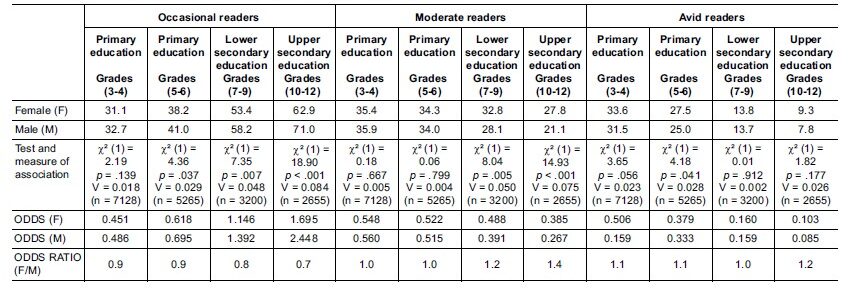
The information presented in Table 3 deepens the analysis of reading practices by enabling an examination of theirintensity through the segmentation of students by reader type[6] (occasional, moderate, and avid), sex, and level of education.
Table 3 Reader types by sex and level of education
(percentage of “yes” responses, odds ratio and test and measure of association)
Notes:
i) Number of books read in the past 12 months:
Occasional readers = 1-4 books (primary education, 2021); 1-3 books (lower and upper secondary education, 2019).
Moderate readers = 5-10 books (primary education, 2021); 4-10 books (lower and upper secondary education, 2019).
Avid readers = 11 or more books across all stages and levels of education (2019 and 2021).
ii) The data are based on responses to the following questions: Primary education: “About how many books did you read in the past year, not counting school
textbooks?”; Lower and upper secondary education: “About how many books did you read for pleasure during the past 12 months?”.
Source: CIES-Iscte (2019) (PLEP, lower and upper secondary education); CIES-Iscte (2021) (PLEP, primary education).
Overall, the analysis reveals that, as students progress through schooling, reading practices become less frequent and gender differences tend to become more pronounced among occasional and moderate readers. Association tests (chi-square) and Cramér’s V coefficients indicate statistically significant differences (p < .01) in lower and upper secondary education, within these reader groups, with greater intensity in the final stage of compulsory schooling (V=0.084 and V=0.075, respectively). However, these associations are weak. Regarding avid readers, a clearly distinct pattern emerges: gender differences are not statistically significant (p <.01), with odds ratios very close to parity (between 1.0 and 1.2). This lack of statistical association between gender and intensive reading constitutes a relevant and analytically distinct finding, in clear contrast with the patterns observed in the other segments.
The group of avid readers clearly challenge the dominant trend of gender divide in reading practices, constituting empirically robust and theoretically relevant evidence. The parity observed in this segment, in contrast with other profiles, suggests the existence of intensive socialisation trajectories that are less constrained by dominant gender norms, in which reading is appropriated as an identity practice. Intensive reading thus appears to constitute a space that is less permeable to social gender norms or,at least, one marked by greater detachment from hegemonic models of masculinity and femininity that constrain students’ practices. This finding does not preclude the possibility of differences in the types of books read, their demands, or the meanings attributed to reading; however, this hypothesis does not compromise the central evidence: among the most intensive readers, gender loses explanatory power as a factor shaping practice. This result constitutes a solid basis for future research, particularly qualitative in nature, aimed at exploring internal variations within the group of avid readers and the conditions favouring the emergence of these less predictable gender trajectories. This interpretation is reinforced by findings from a recent study (Mata et al., 2025), which identified a higher proportion of avid readers among students with elevated familial cultural capital.
How students choose the books they read and what they think about reading
The analysis of reading practices gains depth when considering the forms of symbolic relationship with reading, including the role played by socialisation agencies and the dispositions internalised by students in relation to reading activity. Within this framework, attention shifts to the processes of mediation associated with reading, seeking to identify the types of influence on book choice and to explore how these choices and perceptions are structured differently according to gender and level of education. This approach makes it possible to clarify the articulation between reading practices, socialisation agencies, and symbolic dispositions, thus paving the way for understanding the mechanisms involved in the reading trajectories of girls and boys.
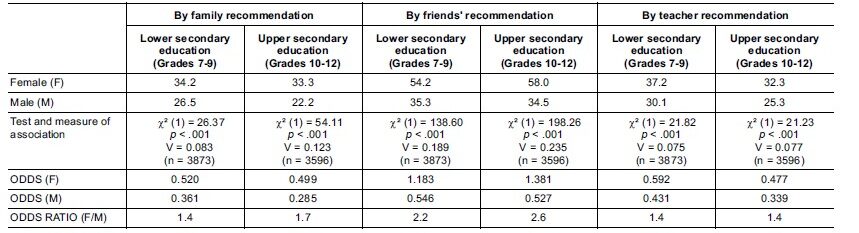
The information presented in Table 4 highlights the influence exerted by family, friends, and teacher(s) on the choice of books that students report reading, contributing to the identification of potential explanatory factors for the widening of gender differences in reading practices in the final stages of compulsory schooling. Female students report higher percentages than males at all levels of education, indicating a stronger influence of the main socialising agencies in book selection.
Table 4 Book choice by level of education and sex
(percentage of “yes” responses, odds ratio, and test and measure of association)
Note: Data are based on responses to the question: “How do you choose the books you read?”
Source: CIES-Iscte (2019) (PLEP, lower and upper secondary education).
According to the responses obtained, friends are the agency most frequently acknowledged in book selection for both sexes, though with unequal expression. Among boys, this influence is declared in around 35% of cases, whereas among girls it exceeds 54% in lower secondary education and rises to nearly 60% in upper secondary education. The latter figure constitutes an exception to the general pattern: among girls, the influence of friends increases during the transition to upper secondary education, making it the only category of mediation for which the percentage rises at this stage.
The data thus show that book selection is shaped by socially structured networks of influence, with gender-differentiated patterns. Association tests (chi-square) and Cramér’s V coefficients confirm that the observed gender differences are statistically significant across all indicators analysed (p < .001). The strength of association ranges from weak (V = 0.075 for teacher recommendation at upper secondary education) to weak-to-moderate (V = 0.235 for friend recommendation at upper secondary education). These associations are systematically higher in the latter years of compulsory schooling.
These results reinforce the idea that girls establish denser relationships with the main socialising agencies of reading, being more receptive to familial, teacher, and especially peer mediation. This finding is further supported by odds ratios, which range between 1.4 and 2.6, with the highest values for “recommended by friends”, where girls are 2.6 times more likely than boys to indicate this influence in upper secondary education.
This combination of evidence suggests greater articulation between the main socialisation agencies (Giddens, 1992; Parsons, 1959) in the formation of feminine reader dispositions, supporting the idea of a cumulative process. The information presented allows the argument that reading among girls is sustained by multiple, denser, and more plural chains of symbolic reinforcement, while among boys’ recourse to these sources of support and legitimation is more limited. This difference seems to confirm the argument that plural socialisations marked by coherent and convergent principles favour the consolidation of practices, whereas the absence or greater dispersal of such support may weaken adherence to practices like reading, especially among groups for whom reading is symbolically constructed as a feminine activity.
The greater density and plurality of mediations among girls therefore contribute to a widening of gender differences in reading practices during the final stages of compulsory schooling, in line with the results shown in previous tables. This pattern is particularly evident in the influence exerted by friends and family, with girls displaying significantly higher percentages and odds ratios. The combination of greater exposure to socialising agencies and higher receptiveness to their influence seems to reinforce more consistent and socially legitimised reading dispositions among girls, especially in upper secondary education.
Beyond the influence of socialising agencies on book selection, it is also important to deepen the analysis of the dispositions guiding students’ relationship with reading. While the data analysed so far reveal who influences book choices and which mediation patterns are most frequent, it now becomes relevant to examine how students position themselves in relation to reading as a cultural practice. To this end, a cluster analysis was conducted to identify reading relationship profiles among students in lower and upper secondary education, structured on combined response patterns to a set of evaluative statements (described in the methodology).
Four reading relationship profiles (see Figure 1) were identified through cluster analysis:
- Instrumental (35.6%): reading is mainly associated with practical functions and is neither rejected nor valued as a pastime or topic of conversation;
- Enthusiastic (33.1%): reading is associated with pleasure and valued as a form of sociability, with the idea of obligation or waste of time being rejected;
- Disbeliever (18.1%): reading is regarded as an irrelevant or negative activity;
- Indifferent (13.2%): reading is neither valued nor openly rejected.
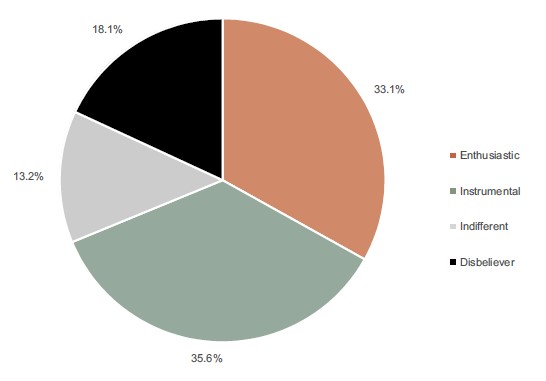
Figure 1 Distribution of students’ reading relationship profiles (percentage)
Source: CIES-Iscte (2019) (PLEP, lower and upper secondary education).
N = 7.469
The analysis shows that the Instrumental and Enthusiastic profiles predominate, together representing over two thirds of students (68.7%). This indicates that, in most cases, students maintain a positive, utilitarian, or pragmatic relationship with reading. It is also important to note the minority profiles, which represent forms of symbolic distancing from reading. The Disbeliever profile (18.1%) constitutes the most distinctly negative group, viewing reading as an uninteresting, unnecessary activity or an imposed obligation, devoid of utility or pleasure. This represents an active rejection, often coupled with dispositions more distant from school culture. For their part, the Indifferent profile (13.2%) expresses a more passive or detached form of devaluation: they do not openly oppose reading, but neither do they recognise it as a relevant activity in their daily lives. This stance may reflect an absence of significant socialisation around reading, or an intermittent and diffuse relationship with the cultural object. The identification of these two profiles reinforces the idea that reading is not universally valued and that, for a significant proportion of students (around one third), symbolic investment in reading is weak, diffuse, or even non-existent. These findings also highlight the importance of differentiating between active rejection and passive disinterest, as they imply distinct socialisation dynamics and require differentiated mediation strategies.
The analysis of the distribution of reading relationship profiles reveals very marked differences between girls and boys across all levels of education (Table 5). In lower secondary education, nearly half of the girls (43.5%) exhibit a reading relationship characterised by pleasure, motivation, engagement, and conviction, placing them in the Enthusiastic profile. The Instrumental profile also holds considerable weight (34.2%), with about one in three female students displaying a more functional and pragmatic relationship with reading. Among boys, only 19.0% display an Enthusiastic relationship, with the Instrumental (37.7%) and Disbeliever (27.2%) profiles predominating, the latter being associated with symbolic devaluation of reading.
Table 5 Reading relationship profiles by sex and level of education
(percentage)
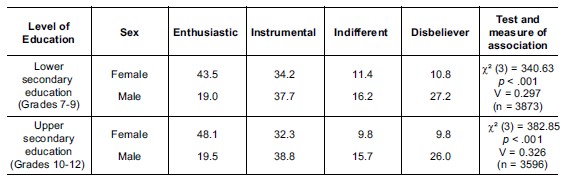
Source: CIES-Iscte (2019) (PLEP, lower and upper secondary education).
In upper secondary education, this divide tends to widen. The proportion of girls classified within the Enthusiastic profile rises to 48.1%, while the figure for boys remains nearly unchanged (19.5%). In turn, the Instrumental (38.8%) and Disbeliever (26.0%) profiles continue to be predominant among male students. The Indifferent profile also deserves attention, as its positioning may reflect a fragile integration of reading into socialisation processes or the presence of contradictory socialisations. This profile is more prevalent among boys (16.2% in lower secondary education and 15.7% in upper secondary education), reinforcing the notion that distancing from reading can manifest in different forms: an overt rejection (the Disbeliever profile) or a detached and apathetic relationship (the Indifferent profile).
The relative stability in the distribution of reading relationship profiles across levels of education suggests that dispositions are formed early and tend to remain consistent throughout compulsory schooling. Nevertheless, some adjustments can be observed in the transition to upper secondary education. Among girls, the most notable change is the increase in the Enthusiastic profile, alongside a decrease in the Instrumental, Indifferent, and Disbeliever profiles. Among boys, a slight increase in the Enthusiastic profile is observable, accompanied by a similarly modest decline in the Indifferent profile. More pronounced, however, is the decrease in the Disbeliever profile, which is matched by an almost equivalent increase in the Instrumental profile. This shift may be interpreted as a dispositional adjustment oriented by curricular demands, whereby reading ceases to be openly rejected and comes to be recognised as a useful practice, albeit one lacking symbolic or affective value. This functional adjustment underlines the plasticity of dispositions and their potential reconfiguration in response to educational contexts and normative pressures.
Association tests (chi-square) and Cramér’s V coefficients (V = 0.297 in lower secondary education and V = 0.326 in upper secondary education) confirm that gender differences are statistically significant (p<0.001) and indicate a moderate association across all levels of education. The data thus demonstrate that gender divides in types of reading relationship are robust and tend to deepen in the final stages of compulsory schooling. This intensification of dispositional segmentation aligns with information analysed in previous tables, pointing to processes of differentiated and cumulative socialisation throughout school trajectories.
In this domain, it becomes relevant to identify how different socialisation agencies contribute to sustaining or transforming these dispositions, particularly in relation to the identified profiles. Table 6 allows a deeper examination of this articulation by crossing reading relationship profiles with the main mediators reported by students, according to sex and level of education.
Table 6 Book choice according to reading relationship profiles, by level of education and sex
(percentages of “yes” responses to choosing books by family, friends, and teacher recommendation, with test and measure of association)
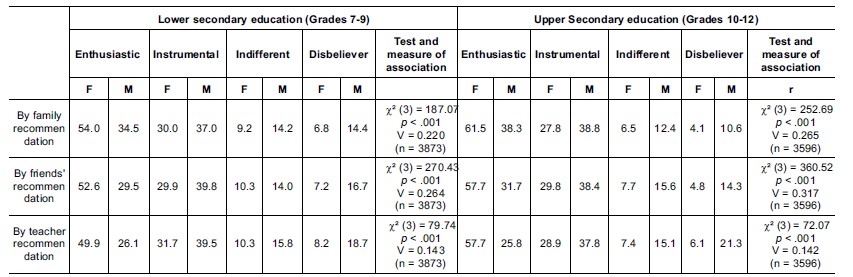
Source: CIES-Iscte (2019) (PLEP, lower and upper secondary education).
The analysis of affirmative responses regarding the influence of family, friends, and teachers clarifies how these mediation instances contribute to sustaining or undermining reading practices, while also revealing marked changes during the transition to upper secondary education. The data show that students within the Enthusiastic profile most frequently report mediation by all socialising agencies. Within this profile, girls stand out clearly, displaying systematically higher values across all levels of education. In lower secondary education, 54.0% report family influence, 52.6% friends, and 49.9% teachers; in upper secondary education, these figures rise to 61.5%, 57.7%, and 57.7%, respectively. This association suggests that the appreciation of reading is built and consolidated through a cumulative chain of social reinforcement and legitimisation, particularly dense among girls, and appears to support the persistence of the gender divide in reading practices. Family influence is especially prominent, being the most frequently cited agency among girls in this group (61.5%), which suggests the existence of early reading-oriented socialisations supported by high cultural capital and consistent symbolic models.
In contrast, at the opposite extreme, the Disbeliever profile, expressing rejection or devaluation of reading, concentrates the lowest observed levels of reference to mediation, particularly in upper secondary education and in relation to family and peer influence. This pattern suggests a disengagement from cultural socialisation networks and may be associated with more fragile or interrupted trajectories.
The behaviour of students within the Instrumental profile, whose motivation appears oriented towards utilitarian goals, also warrants attention. This group occupies an intermediate position between the Enthusiastic and Disbeliever profiles, characterised by levels of mediation that are neither residual nor fully convergent. In lower secondary education, references to mediation occur at moderate levels, indicating the presence of social influences that sustain a relationship with reading, albeit in a less dense and less cumulative manner than in the Enthusiastic profile. Within this group, boys report higher levels of mediation across all agencies. Among girls, reported mediation remains lower than in the Enthusiastic profile but higher than in the Indifferent and Disbeliever profiles, pointing to forms of engagement with reading supported by partial and fragmented mediation networks rather than by dense and cumulative chains of symbolic reinforcement. A similar configuration is observed in upper secondary education.
Statistical tests confirm a significant association between reading profile, gender, and mediation agency in all intersections, with high chi-square values and Cramér’s V coefficients ranging from 0.14 to 0.31. The strength of these associations is generally moderate but shows a clear tendency to strengthen in upper secondary education. This increase in relational intensity, particularly regarding the influence of friends (V = 0.317), supports the thesis of deepening gender divides throughout compulsory schooling. As they progress through their educational pathways, boys and girls reveal increasingly differentiated dispositional trajectories and mediation networks, reflecting cumulative socialisations and contrasting symbolic orientations towards reading.
Conclusions
This study provides further evidence of structural differences in book reading practices between girls and boys enrolled in primary and secondary education in Portugal, showing that these divides emerge early, shortly after reading acquisition, and become more pronounced throughout compulsory schooling. Statistical analyses indicate that, regardless of the indicator used to assess reading practices, girls exhibit a significantly higher probability of maintaining more regular, intense, and sustained reading habits. This trend, however, shows a notable inflection when focusing exclusively on avid readers, a minority group in which gender differences blur or vanish, ceasing to be statistically significant across all educational levels. This evidence points to the existence of relatively autonomous trajectories that resist gender constraints, allowing some boys to maintain an intense and sustained relationship with reading, thus contradicting the overall pattern. Gender dispositions can thus be challenged and reconfigured in specific contexts, highlighting the importance of familial and sociocultural factors, such as the presence of early socialisations strongly focused on reading, the existence of cultural models supported by high volumes of cultural capital, and the internalisation of reading as an identity practice. Consequently, plural and intensive socialisations with reading can produce less predictable trajectories, even in contexts marked by persistent gender norms.
The exploration of students’ dispositions towards reading, through cluster analysis, identified four distinct profiles of relationship with this practice: Enthusiastic, Instrumental, Indifferent, and Disbeliever. Girls predominate in the Enthusiastic profile, associated with reading for pleasure, more regular habits, and stronger influence from socialisation agencies, whereas boys are more frequently represented in the Instrumental, Disbeliever, and Indifferent profiles, reflecting greater symbolic distance from reading. This typology shows that reading dispositions are not distributed homogeneously either within gender groups or across educational levels. At the same time, it confirms the existence of statistically significant patterns pointing to processes of differentiated socialisation, revealing the persistence of a strongly internalised “sex ethos” (Bourdieu, 1979b), which underscores the strength and stability of gendered dispositions. The identified reading relationship profiles thus result from socially structured pathways articulating socialisation agencies, dispositions, and reading practices.
Gender differences in reading-related dispositions should thus be interpreted as products of social trajectories, structured by the combined action of the main socialisation agencies—family, school, and peers. These tend to transmit, from early age, more cohesive, convergent, and durable dispositions among girls regarding reading. This greater normative and symbolic consistency favours cumulative processes of reinforcement and legitimisation of reading practices. This finding contributes to understanding why girls identified with the Enthusiastic profile (reading for pleasure) exhibit particularly high levels of influence from different socialisation agencies, markedly distinguishing themselves from boys who display less intense mediations. Girls’ trajectories more frequently benefit from chains of symbolic reinforcement that consolidate the value of reading as a pleasurable, socially recognised, and legitimate practice. Therefore, identifiable intensive socialisation trajectories emerge, marked by early and frequent exposure to reading through multiple convergent socialising agencies. Reading for pleasure thus appears associated with regular practices formed within the framework of early, plural, cumulative, and convergent socialisations.
The persistence of gender differences in reading practices should therefore be understood as the result of social processes that can become the focus of public intervention. The analysis presented in this article highlights the need for public policies promoting reading, as well as pedagogical strategies aimed at countering cultural reproduction logics, which require recognising the significance of gender in the relationship with books and reading. It is also important in this domain to support families in their central mediating role, by creating conditions for the construction and consolidation of reading dispositions from children’s earliest years.
Finally, these findings open relevant pathways for future sociological research on socialisation processes and reading practices, particularly through qualitative methodologies. An in-depth exploration of students who appear more resistant to the “sex ethos” such as avid male readers, boys in the Enthusiastic profile, or girls in the Disbeliever profile, may reveal mechanisms through which students incorporate, interpret, transform, and contest dominant cultural norms. It will also be important to explore other axes structuring students’ reading dispositions and practices, such as youth cultures, social class, ethnic origin, and territory, thereby contributing to a more nuanced analysis of reading differences and to the design of informed public policies reflecting the diversity of social experiences.
References
Abrantes, P. (2011). Para uma teoria da socialização. Sociologia. Revista da Faculdade de Letras da Universidade do Porto, XXI, 121-139.
Abrantes, P., Santos, S., & Schippling, A. (2024). Socialização, trajetórias educativas e internacionalização entre jovens das classes dominantes. Revista Crítica de Ciências Sociais, 134, 51-74.
Almeida, A. N. de, Alves, N. de A., & Delicado, A. (2011). As crianças e a internet em Portugal: Perfis de uso. Sociologia, Problemas e Práticas, 65, 9-30.
Ariño Villarroya, A. (2010). Cultura mediada, diversidade e estratificação social: Para uma sociologia das práticas culturais em Espanha. In M. de L. L. dos Santos & J. M. Pais (Eds.), Novos Trilhos Culturais. Práticas e Políticas (pp. 191-215). Imprensa de Ciências Sociais.
Baudelot, C., & Cartier, M. (1998). Lire au collège et au lycée: De la foi du charbonnier à une pratique sans croyance. Actes de la recherche en sciences sociales, 123(1), 25-44. https://doi.org/10.3406/arss.1998.3253
Baudelot, C., & Establet, R. (2007). Quoi de Neuf Chez les Filles? L’enfance en Questions. Éditions Nathan. https://www.amazon.com/-/pt/dp/B005TJT990/
Bauman, Z. (2000). Liquid Modernity. Polity Press.
Bourdieu, P. (1979a). Les trois états du capital culturel. Actes de la recherche en sciences sociales, 30, 3-6. https://doi.org/10.3406/arss.1979.2654
Bourdieu, P. (1979b). La Distinction. Critique Sociale du Jugement. Les Éditions de Minuit
Bourdieu, P. (1990). La domination masculine. Actes de la Recherche en Sciences Sociales, 84, 2-31. https://doi.org/10.3406/arss.1990.2947
Bourdieu, P. (1993). À propos de la famille comme catégorie réalisée. Actes de la recherche en sciences sociales, 100, 32-36. https://doi.org/10.3406/arss.1993.3070
Bourdieu, P. (2005). Distinction: A social critique of the judgement of taste. Routledge.
Bourdieu, P. (2013). Outline of a theory of practice. Cambridge University Press.
Bourdieu, P, & Chartier, R. (1993). La lecture: une pratique culturelle. In R. Chartier (Ed.), Pratiques de la Lecture (pp. 267-294). Éditions Payot & Rivages.
Bourdieu, P., & Passeron, J.-C. (1964). Les héritiers: Les étudiants et la culture. Les Éditions de Minuit.
Bourdieu, P., & Passeron, J.-C. (1978). A reprodução: Elementos para uma teoria do sistema de ensino. Editorial Vega.
Butler, J. (2021). Gender trouble: Feminism and the subversion of identity. Routledge.
Cameira, E. (2022). A leitura e a frequência de bibliotecas e arquivos no arranque dos anos 20 do século XXI. In J. M. Pais, P. Magalhães, & M.L. Antunes (Eds.), Práticas Culturais dos Portugueses. Inquérito 2020 (pp. 143-196). Imprensa de Ciências Sociais.
CIES-Iscte. (2019). PLEP – Portuguese Longitudinal Education Panel. Lower secondary education and upper secondary education [Database]. CIES-Iscte.
CIES-Iscte. (2021). PLEP – Portuguese Longitudinal Education Panel. Primary education [Data set]. CIES-Iscte.
Clark, C., & Akerman, R. (2008). Being a reader: The relationship with gender. National Literacy Trust. https://literacytrust.org.uk/research-services/research-reports/young-peoples-self-perceptions-readers-2008/
Clark, C., & Picton, I. (2020). Children and young people’s reading in 2020 before and during the COVID-19 lockdown. National Literacy Trust. https://literacytrust.org.uk/research-services/research-reports/children-and-young-peoples-reading-in-2020-before-and-during-the-covid-19-lockdown/
Clark, C., & Rumbold, K. (2006). Reading for pleasure: A research overview. National Literacy Trust. https://files.eric.ed.gov/fulltext/ED496343.pdf
Clark, C., & Teravainen, A. (2017). Book ownership and reading outcomes. National Literacy Trust.
Clark, C., & Teravainen-Goff, A. (2020). Children and young people’s reading in 2019: Findings from our Annual Literacy Survey. National Literacy Trust. https://literacytrust.org.uk/research-services/research-reports/children-and-young-peoples-reading-in-2019/
Clark, C., Osborne, S., & Akerman, R. (2008). Young People’s Self-Perceptions as Readers. National Literacy Trust. https://literacytrust.org.uk/research-services/research-reports/young-peoples-self-perceptions-readers-2008/
Connell, R. W. (2005). Masculinities. University of California Press.
Cremin, T. (2007). Revisiting reading for pleasure: Delight, desire and diversity. In K. Goouch & A. Lambirth (Eds.), Understanding Phonics and the Teaching of Reading: A Critical Perspective (pp. 166-190). McGraw Hill.
Cremin, T. (2020). Reading for Pleasure: Challenges and opportunities. In J. Davison & C. Daly (Eds.), Debates in English Teaching. Routledge.
Cremin, T., & McGeown, S. (2025). Reading for pleasure: Exploring the concept, the causes and consequences. In T. Cremin & S. McGeown (Eds.), Reading for pleasure: International perspectives [Kindle eBook]. Routledge.
Direção-Geral de Estatísticas da Educação e Ciência [DGEEC]. (2019). Distribuição das crianças e dos alunos matriculados/inscritos, por natureza do estabelecimento de ensino e nível de ensino. Direção-Geral de Estatísticas da Educação e Ciência.
Direção-Geral de Estatísticas da Educação e Ciência [DGEEC]. (2021). Distribuição das crianças e dos alunos matriculados/inscritos, por natureza do estabelecimento de ensino e nível de ensino. Direção-Geral de Estatísticas da Educação e Ciência.
Donnat, O. (2005). Les pratiques culturelles des Français: évolutions et tendances. La Découverte ; Ministère de la Culture et de la Communication.
Eloy, F., Bónnéry, S., & Legon, T. (2020). L’impossible dépassement des stéréotypes de genre? L’exemple de Virus, de la production culturelle à la réception critique. ENS Éditions.
Encinas-Martín, M., & Cherian, M. (2023). Gender, Education and Skills: The Persistence of Gender Gaps in Education and Skills. OECD Publishing. https://doi.org/10.1787/34680dd5-en
Espanha, R. (2012). Práticas da e-generation em Portugal: Resultados de estudos e questões contemporâneas. In C. Ponte, A. Jorge, J. A. Simões, & D. Cardoso (Orgs.), Crianças e Internet em Portugal: Acessos, usos, riscos, mediações: Resultados do inquérito europeu EU Kids Online (pp. 41-53). Minerva Coimbra.
Giddens, A. (1991). Modernity and self-identity: Self and society in the late modern age. Polity Press.
Giddens, A. (1992). Sociology. Blackwell Publishers.
Goffman, E. (1977). The arrangement between the sexes. Theory and Society, 4(3), 301-331. https://doi.org/10.1007/BF00206983
Guhin, J., Calarco, J., & Miller-Idriss, C. (2021). Whatever happened to socialization? Annual Reviews of Sociology, 47, 109-29.
Krashen, S. D. (2004). The Power of Reading: Insights from the Research. Heinemann.
Kucirkova, N., & Cremin, T. (2020). Children Reading for Pleasure in the Digital Age. SAGE.
Lages, M. F., Sofia, C. L., António, J. H. C., & Correia, T. S. (2007). Os Estudantes e a Leitura. GEPE – Gabinete de Estatística e Planeamento da Educação.
Lahire, B. (1998). Matrices disciplinaires de socialisation et lectures étudiantes, BBF, 43(5), 58-61.
Lahire, B. (2001). Héritages sexués: incorporation des habitudes et des croyances. In Blöss, T. (Ed.). La dialectique des rapports hommes-femmes. (pp. 9-25). Presses Universitaires de France. https://doi.org/10.3917/puf.bloss.2001.02.0009
Lahire, B. (2003). O homem plural: As molas da acção. Instituto Piaget.
Lahire, B. (2005). Patrimónios individuais de disposições: Para uma sociologia à escala individual. Sociologia, Problemas e Práticas, (49), 11-42.
Lahire, B. (2006). A cultura dos indivíduos. Artmed.
Lahire, B. (2008). Sucesso Escolar nos Meios Populares. Editora Ática.
Lahire, B. (2019). Enfances de classe: De l’inégalité parmi les enfants. Seuil.
Lopes, J. T., & Antunes, L. (2001). Novos hábitos de leitura: Análise comparativa de caso. Instituto Português do Livro e das Bibliotecas. Observatório das Atividades Culturais.
Marôco, J. (2021). Análise Estatística com o SPSS Statistics 27. ReportNumber.
Mata, J.T. da, Neves, J. S. (Eds.), Lopes, M. A., & Ávila, P. (2020). Práticas de Leitura dos Estudantes dos Ensinos Básico e Secundário – Primeiros resultados, apresentação realizada a 30 de setembro, Iscte.
Mata, J. T. da, Neves, J. S. (Eds.), Lopes, M. A., & Ávila, P. (2021). Práticas de Leitura dos Estudantes Portugueses – 1.º e 2.º Ciclos, apresentação realizada a 7 de dezembro, Iscte.
Mata, J. T. da, Neves, J. S., Ávila, P., & Lopes, M. A. (2025). Perfis e práticas de leitura de livros dos alunos em Portugal. Sociologia, Problemas e Práticas, 107, 53-79.
Melo, D. (2020). Debates sobre a cultura em Portugal: O complexo caso do livro e da leitura. Sociologia, Problemas e Práticas, 94, 97-118. https://doi.org/10.7458/SPP20209414027
Merga, M. K. (2014a). Exploring the role of parents in supporting recreational book reading beyond Primary School. English in Education, 48(2), 149-163. https://doi.org/10.1111/eie.12043
Merga, M. K. (2014b). Peer Group and Friend Influences on the Social Acceptability of Adolescent Book Reading. Journal of Adolescent & Adult Literacy, 57(6), 472-482. https://doi.org/10.1002/jaal.273
Merga, M. K. (2021). How can Booktok on TikTok inform readers’ advisory services for young people? Library & Information Science Research, 43(2), 101091. https://doi.org/10.1016/j.lisr.2021.101091
Merga, M. K., & Roni, S. M. (2018a). Empowering Parents to Encourage Children to Read Beyond the Early Years. Reading Teacher, 72(2), 213-221. https://doi.org/10.1002/trtr.1703
Merga, M. K., & Roni, S. M. (2018b). Parents as Social Influences Encouraging Book Reading: Research Directions for Librarians’ Literacy Advocacy. Journal of Library Administration, 58(7), 674-697. https://doi.org/10.1080/01930826.2018.1514841
Merle, P. (2009). La Démocratisation de L’Enseignement. La Découverte.
Monge, R., & Quesada, M. (2019). Hábitos y disposiciones hacia lectura recreacional entre la población estudiantil de la Universidad Estatal a Distancia de Costa Rica: Una aproximación sociológica desde el capital cultural. In M. Olaza, F. Arocena, & E. A. Sandoval Forero (Orgs.), Sociología de la cultura, arte e interculturalidad (pp. 171-190). Teseo.
Mullis, I., Von Davier, M., Foy, P., Fishbein, B., Reynolds, K., & Wry, E. (2023). PIRLS 2021 International Results in Reading. TIMSS & PIRLS International Study Center. https://doi.org/10.6017/lse.tpisc.tr2103.kb5342
Muntoni, F. & Retelsdorf, J. (2018). Gender-specific teacher expectations in reading – The role of teachers’ gender stereotypes. Contemporary Educational Psychology, 54, 212-220. https://doi.org/10.1016/j.cedpsych.2018.06.012
Muntoni, F. & Retelsdorf, J. (2019). At their children’s expense: How parents’ gender stereotypes affect their children’s reading outcomes. Learning and Instruction, 60, 95-103. https://doi.org/10.1016/j.learninstruc.2018.12.002
Neves, J. S. (2011). Práticas de Leitura da População Portuguesa no Início do Século XXI [Doctoral dissertation, Iscte-Instituto Universitário de Lisboa]. http://hdl.handle.net/10071/6696
Nunes, A. F. (2019). Estereotipos de xénero nos libros infantís premiados. Elos: Revista de Literatura Infantil e Xuvenil, 6, 77-97. https://doi.org/10.15304/elos.6.5867
Octobre, S. (2005). La Fabrique sexuée des goûts culturels: Construire son identité de fille ou de garçon à travers les activités culturelles. Développement Culturel, 150, 1-10.
Organisation for Economic Co-operation and Development. (2002). Reading for Change: Performance and Engagement across Countries: Results from PISA 2000. OECD Publishing. https://doi.org/10.1787/9789264099289-en
Organisation for Economic Co-operation and Development. (2010). PISA 2009 Results: Learning to Learn – Student Engagement, Strategies and Practices (Volume III). PISA, OECD Publishing. http://dx.doi.org/10.1787/9789264083943-en
Organisation for Economic Co-operation and Development. (2019a). PISA 2018 Results (Volume I): What Students Know and Can Do. PISA, OECD Publishing. https://doi.org/10.1787/5f07c754-en
Organisation for Economic Co-operation and Development. (2019b). PISA 2018 Results (Volume II): Where All Students Can Succeed. PISA, OECD Publishing. https://doi.org/10.1787/b5fd1b8f-en
Organisation for Economic Co-operation and Development. (2021). 21st-Century Readers: Developing Literacy Skills in a Digital World. PISA, OECD Publishing. https://doi.org/10.1787/a83d84cb-en
Parsons, T. (1959). The school class as a social system: Some of its functions in American society. Harvard Educational Review, 29(4), 297-318.
Parsons, T. (1971). System of Modern Societies. Prentice Hall.
Pennington, M. C., & Waxler, R. P. (2018). Why Reading Books Still Matters. The Power of Literature in Digital Times. Routledge.
Ross, C. S., McKechnie, L., & Rothbauer, P. M. (2006). Reading matters: What the research reveals about reading, libraries, and community. Libraries Unlimited.
Ross, C. S., McKechnie, L., & Rothbauer, P. M. (2018). Reading still matters: What the research reveals about reading, libraries, and community. Libraries Unlimited.
Santos, M. de L. L. dos (Coord.), Neves, J. S., Lima, M. J., & Carvalho, M (2007). A Leitura em Portugal. Lisboa, Gabinete de Estatística e Planeamento da Educação.
Scholes, L. (2015). Clandestine Readers: boys and girls going “undercover” in school spaces. British Journal of Sociology of Education, 36(3), 359-374. https://doi.org/10.1080/01425692.2013.826899
Scholes, L. (2017a). Books Are Boring! Books Are Fun! Boyhood Studies, 10(2), 77-98. https://doi.org/10.3167/bhs.2017.100205
Scholes, L. (2017b). Boys, Masculinities and Reading. Routledge.
Scholes, L. (2019a). Differences in attitudes towards reading and other school-related activities among boys and girls. Journal of Research in Reading, 42(3-4), 485-503. https://doi.org/10.1111/1467-9817.12279
Scholes, L. (2019b). Working-class boys’ relationships with reading: Contextual systems that support working-class boys’ engagement with, and enjoyment of, reading. Gender and Education, 31(3), 344-361. https://doi.org/10.1080/09540253.2018.1533921
Scholes, L. (2020). Recognition of boys as readers through a social justice lens. British Journal of Sociology of Education, 41(7), 975-991. https://doi.org/10.1080/01425692.2020.1802227
Scholes, L. (2021). Popular girls aren’t into reading: Reading as a site for working-class girls’ gender and class identity work. Critical Studies in Education, 62(2), 179-194. https://doi.org/10.1080/17508487.2019.1601633
Scholes, L., Spina, N., & Comber, B. (2021). Disrupting the “boys don’t read” discourse: Primary school boys who love reading fiction. British Educational Research Journal, 47(1), 163-180. https://doi.org/10.1002/berj.3685
Schüller, E. M., Birnbaum, L., & Kröner, S. (2016). What Makes Elementary School Students Read in Their Leisure Time? Development of a Comprehensive Questionnaire. Reading Research Quarterly, 52(2), 161-175. https://doi.org/10.1002/rrq.164
Segré, M. (2001). Itinéraires de lecteurs: Note critique sur des études récentes en sociologie de la lecture. Revue Française de Sociologie, 42(1), 149-164. https://doi.org/10.2307/3322807
Simmel, G. (2009). Sociology: Inquiries into the Construction of Social Forms (A. J. Blasi, A. K. Jacobs, &M. Kanjirathinkal, Trans.). Brill. (1908). https://doi.org/10.1163/ej.9789004173217.i-698
Tepper, S. J. (2000). Fiction reading in America: Explaining the gender gap. Poetics, 27(4), 255-275. https://doi.org/10.1016/S0304-422X(00)00003-6
Wollscheid, S. (2014). The impact of the leisure reading behaviours of both parents on children’s reading behaviour: Investigating differences between sons and daughters. Poetics, 45, 36-54. https://doi.org/10.1016/j.poetic.2014.06.001
Date submitted: 06/08/2025 | Date accepted: 16/09/2025
Notas
[1] Within this framework, the identity-related, performative and subjective dimensions of gender (Butler, 2021; Connell, 2005) are not addressed, as the purpose of this text is not to undertake a theoretical review of gender studies as a specialised disciplinary field.
[2] Since the English translation of Distinction does not include the original footnote cited in this article (Bourdieu, 1979b, p. 90), both the French edition and the English translation are used here.
[3] Survey on the cultural leisure activities of children aged 6 to 14, which encompassed 3,000 families.
[4] This study was commissioned by the National Reading Plan 2027 and conducted at the Centre for Research and Studies in Sociology (CIES-Iscte). It was supported by the body responsible for national education statistics, the Directorate-General for Education and Science Statistics (DGEEC), as well as by the School Libraries Network (RBE), a Ministry of Education programme created in 1996, which encompasses 2538 school libraries, each managed by a teacher-librarian. The RBE collaborated in implementation the school survey, particularly in administering the digital version of the questionnaire, under the supervision of the research team (Mata et al., 2020, 2021).
[5] The ratio between the probabilities of a given event occurring in one group compared with another. A value of 1.0 indicates no difference between groups (parity). Values greater than 1.0 indicate that the event is more likely in the group placed in the numerator, whereas values below 1.0 indicate a higher probability in the denominator group. In the present study, odds ratios were calculated by placing girls in the numerator and boys in the denominator, based on the observed values of reading practices, thereby allowing an assessment of the relative magnitude of gender differences.
[6] The classification is based on the number of books read in the last 12 months, with scales adjusted to the different stages of schooling, as specified in the note to Table 3.
Autores: João Trocado da Mata, José Soares Neves, Miguel Ângelo Lopes e Andreia Nunes